
The COVID-19 pandemic has disrupted the education of New Hampshire’s 163,000 public school students and has put them at risk for lasting setbacks to their educational, emotional, and social development. While educators, administrators, parents, and students have rallied to adapt to these unprecedented circumstances, they collectively face yet another hurdle as legislators deliberate over the next biennium’s education funding.
Falling enrollments, emergency changes to the National School Lunch Program (NSLP), and the expiration of special aid categories threaten to reduce state education aid for FY 2022 by nearly $90 million. Though enrollments have declined over the past year, those numbers are expected to rebound as in-person learning resumes, leaving schools short on funding if their aid is tied to today’s depressed figures. At the same time, the federal government has relaxed the requirement for students to submit completed paperwork verifying their eligibility for the NSLP. Because schools typically use this paperwork to measure student needs, this has led to the false appearance of fewer low-income students, another key component of the state’s education funding formula.
On top of these pandemic-related pitfalls, two categories of aid are set to expire entirely in FY22. These categories, additional aid for students eligible for free or reduced-price lunch and financial capacity disparity aid for districts with comparatively low property values, are crucial to supporting schools with the highest needs.
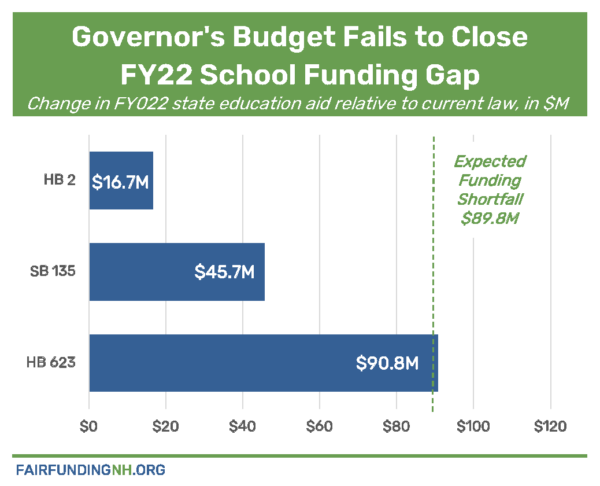
A number of bills seeking to address this problem have been introduced this session, but only one seeks to address it in its entirety. As the following comparison of three major proposals explains, HB 623 represents the most effective approach now before the Legislature for insulating schools from enrollment changes arising from the pandemic and preserving the progress made in the current biennium in mitigating long-standing inequities in New Hampshire’s school funding system. In stark contrast, Governor Sununu’s FY2022-23 budget proposal would solve only a fraction of the problem.
As legislators craft their own version of the FY22-23 budget, it is imperative that they halt the projected decline in state education aid and provide the funding necessary in FY22 and beyond for students to get back on track, to learn, and to thrive.
HB 2
In his February budget address, Governor Sununu signaled his intention to address concerns over reduced differentiated aid linked to students eligible for free or reduced-price lunch. HB 2 (the so-called “trailer” bill or the second half of the Governor’s FY2022-23 budget proposal) presents the specific mechanism he would use. The bill calculates the proportion of a given district’s 2019-2020 enrollment eligible for free or reduced-price lunch and multiplies this percentage by the district’s estimated 2020-2021 total enrollment. It then compares this figure to the district’s 2020-2021 estimate for enrollment of students eligible for free or reduced-price lunch. The greater of these two numbers is used to determine the district’s differentiated aid for low-income students.
While this intervention would alleviate some of the most severe cuts, it would increase state education aid in FY22 by just $16.7 million relative to current law. In other words, it would protect just 1 in 5 vital education funding dollars at risk of being cut. Crucially, HB2 does not include any provisions to address the issues of reduced enrollment generally or the expiration of additional aid and financial capacity disparity aid, leaving many schools largely unprotected.
SB 135
Unanimously approved by the Senate on February 18, SB 135 seeks to mitigate the oncoming education funding shortfall by comparing a district’s total student enrollment and its count of students eligible for free or reduced-price lunch across 2019-2020 and 2020-2021. For both categories, the greater of these years’ figures would be used, negating funding cuts from reduced enrollment and reduced reporting on students eligible for food assistance. Though the bill would preserve roughly $45.7 million in education funding in the coming year, it would close only about half of the anticipated funding gap, as it fails to preserve the expiring forms of state aid described above. Consequently, SB 135’s relatively modest reforms may still leave many cities and towns with little choice but to increase already high local property taxes.
HB 623
HB 623 takes a more comprehensive approach than other school funding legislation. It compares districts’ FY 2021 education grants to their expected FY 2022 grants and provides them with the greater amount; it would do the same in FY 2023 as well. As a result, not only does HB 623 prevent pandemic-induced changes in enrollment from adversely affecting education aid, but also supports higher-need districts by effectively continuing to provide additional aid and fiscal capacity disparity aid. Importantly, in communities, such as Waterville Valley, where enrollments have risen due to an influx of vacation homeowners becoming permanent residents, HB 623 would ensure that they still receive an increase in funding to serve their growing student bodies.
HB 623 has been retained by the House Finance Committee, but its provisions could easily be incorporated into other legislation, including the House’s own version of the FY22-23 budget.
Just as these three proposals would address the impending school funding shortfall to far different degrees, their impact on specific communities would vary considerably as well. The attached tables detail the effects that HB 2, SB 135, and HB 623 would have in each city and town in New Hampshire.


