fbpx

Learn

School Funding

The State of New Hampshire has a fundamental responsibility to ensure that every Granite State child has the opportunity to receive a high quality public education. Yet, for years, the resources the state provides to local communities has fallen far short of what schools need to help children learn and thrive.

The State’s failure to fulfill that responsibility creates tremendous hardships for property-poor towns who must rely on high local property tax rates to make up the difference and to fund school budgets often already cut to the bone.

Here you can learn about New Hampshire’s current approach to school funding, the constitutional principles that are meant to guide school funding in the Granite State, and much more.

How Funding Works Constitutional Principles School Spending Community Info Fact Sheets
How Does New Hampshire Fund its Public Schools?

The State of New Hampshire currently funds only a small portion of the cost of each child’s public school education, with local property taxpayers making up the rest. In fact, the state’s share of education spending is the lowest in the nation. While New Hampshire’s public schools spend about $20,000 per pupil on average, under its current funding formula, the state provides only about $4,800 per pupil in “base adequacy aid” (with somewhat higher amounts for students with greater needs).  With local taxes accounting for more than 70% of education spending, New Hampshire residents are faced with some of the highest property taxes in the country. In “property-poor” communities with less property to tax, residents shoulder an even bigger burden.

Constitutional Principles

In a series of rulings beginning with Claremont School District v. Governor of New Hampshire, New Hampshire’s Supreme Court found that the state must define an adequate education that includes more than mere basics, determine its cost, fund it with constitutional taxes, and ensure its delivery through accountability. The Court has also determined that, if property taxes are used to fund education, they must be levied at a uniform rate.

Nearly 30 years later, the legislature has yet to make good on its constitutional obligations.

To learn more about the principles from New Hampshire’s Constitution that underpin every child’s right to an adequate public education, browse the slides below.

Property Values a Key Factor

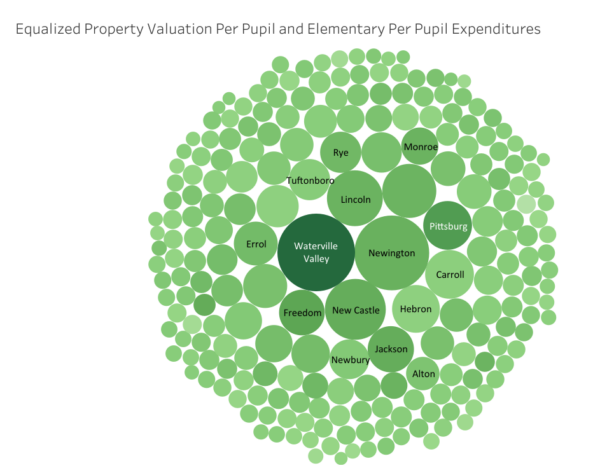
This bubble chart shows how school spending – as measured by elementary per pupil expenditure (or elementary PPE) – varies across the state. It is color-coded so that the darker the color of each bubble, the higher the level of spending in that community. Each bubble is also scaled in size to represent property values in each community. The larger the bubble, the higher the value of property in that city or town.

The chart measures property value as equalized property valuation per pupil (EQVP) – or the total equalized value of all property in a town divided by the number of public-school students residing in that town. As the chart demonstrates, property values are a key factor in school spending throughout New Hampshire – the darkest bubbles in color (higher spending level) also tend to be among the largest bubbles in size (higher property values).

Click here to go to an interactive version of the chart.

Essential Information for Your Community

Ever wonder how the number of students in your local schools may have changed over time?  Want to know how spending in your district compares to the rest of the state?

NHSFFP’s school funding papers answer these questions and more. Visit our directory of town and school district papers and find your community.

Learn About Your Town

“The state’s current system is inequitable from both student and taxpayer perspectives. The districts serving the highest proportion of students who are economically disadvantaged spend less, on average, compared with districts serving the fewest such students. Moreover, the districts with the least property wealth per student impose the highest local education tax rates to be able to fund their children’s education.”

The support of generous donors like you is critical to our success. Please consider becoming a part of the fair funding movement and contributing to our efforts.

Donate