
In formulating its version of New Hampshire’s FY 2022-23 budget, the House Finance Committee identified an additional $100 million in resources for use within the Education Trust Fund. Rather than choosing to allocate those resources toward addressing a looming $90 million decline in state education aid in FY 2022, the Committee voted to dedicate them to a reduction in the state education property tax (often referred to as the SWEPT) in FY 2023. Such a choice will force communities throughout the Granite State to move forward with significant school spending cuts or local school property tax increases in the year ahead and fails to target assistance to communities most in need.
Under current law, the SWEPT is meant to generate $363 million each year, with such funds used to offset the amount of adequate education aid the state provides to each city and town. The version of the FY22-23 budget approved by the House Finance Committee on March 31 sets that figure at $263 million in FY 2023, a $100 million or roughly 27.5 percent reduction.
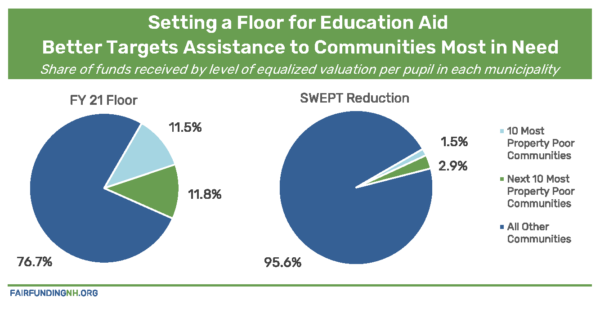
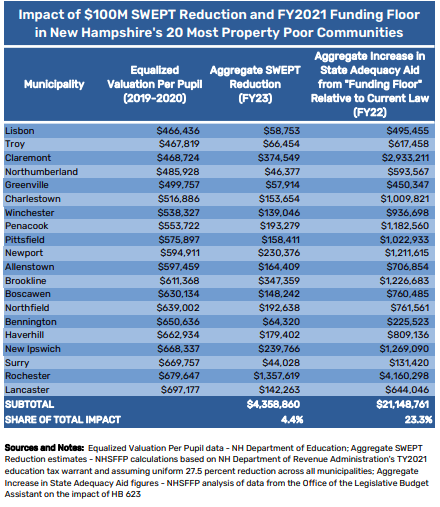
The impact of a SWEPT reduction would be felt by property taxpayers around New Hampshire, but only about 1.5 percent of that reduction would be realized in the 10 most property-poor communities in the state (as measured by equalized valuation per pupil or EVPP). These communities, all of which had EVPP of less than $595,000 for 2019-2020, must rely on much higher local school property tax rates to educate their schoolchildren. Take Charlestown, for instance. Charlestown had an EVPP of about $517,000 – or less than half the statewide average – in 2019-2020; as a result, it had to levy a local school tax rate of $20.34 per thousand (on an equalized basis) to keep its schools running. Going one step further, just 4.4 percent of the funds distributed by the proposed $100 million SWEPT reduction would accrue to the 20 poorest cities and towns in New Hampshire in terms of property values.
In stark contrast, setting a floor under state education aid for the coming biennium would not only largely erase the anticipated $90 million shortfall cities and towns now face but would be far more effective in targeting state resources to where they are needed most.
Legislation introduced earlier this session – HB 623 – would compare the amount of state education aid each community received in FY 2021 with the amount they are slated to receive in FY 2022 and would provide them with the greater amount; it would do the same in FY 2023 as well. As a result, it would prevent pandemic-induced changes in enrollment from adversely affecting education aid. It would also effectively extend two forms of education aid – known as fiscal capacity disparity aid and additional aid – that are designed to assist less affluent cities and towns but that are set to expire this year.
Based on data from the Office of the Legislative Budget Assistant and as the graph above illustrates, nearly a quarter of the benefits arising from the approach embodied in HB 623 would flow to the 20 most property-poor towns in New Hampshire. For instance, Charlestown would see a roughly $154,000 reduction in the amount of SWEPT it collectively owes if that tax were cut by 27.5 percent across the board in FY23. However, it stands to receive more than $1 million (relative to current law) if a floor were set under state education aid in FY22. That $1 million influx could, in turn, be used to bolster support for local schools, to hold down local school property tax rates, or some combination thereof.