Negotiators from the House of Representatives and Senate have completed their work on New Hampshire’s FY2022-23 budget and are poised to present it to their colleagues for their approval when the two chambers meet on June 24. Though state revenue projections for the next years grew over the course of the budget process and left members of the conference committee with far greater resources at their disposal, they chose to use those resources to reduce the taxes paid by wealthy investors and large corporations and to build up the rainy day fund, rather than to strengthen state education aid.
As a result, under the conference committee’s version of the budget, a quarter of all New Hampshire communities would receive less in state education aid in each of the next two fiscal years than they do at present, even after taking a proposed reduction in the statewide property tax into account. The vast majority of those communities, in turn, have property values well below the state average. In short, members of both the House and Senate should reject the proposed FY22-23 budget, for it would leave New Hampshire’s school funding system even less equitable than it already is today and would force cities and towns with the least capacity to shoulder an even heavier load in educating the children of our state.
Result of Conference Committee Negotiations
Negotiations between House and Senate conferees over the provisions of HB 1 and HB 2 related to state education aid were exceedingly brief, with the House accepting all of the changes the Senate had made to its version of the FY22-23 budget. Accordingly, the version of the budget that was approved by members of the conference committee and that will soon be voted upon by the full House and Senate would:
- Compare a district’s total student enrollment and its count of students eligible for free or reduced-price meals from the 2019-2020 school year with the same figures for 2020-2021 and use the higher of each in determining state education aid in FY 2022. Doing so would prevent student counts artificially suppressed by the pandemic and responses to it from reducing state education aid.
- Add a new element, known as “relief funding,” to the state’s education aid formula to direct up to $600 per pupil to communities with high concentrations of low-income students, effectively replacing a similar form of aid, often referred to as “additional assistance”, available in FY .
- Allow fiscal capacity disparity aid to expire at the close of FY 2021, ending a form of aid that allocated more than $40 million to property-poor communities this year.
- Reduce the statewide education property tax (or SWEPT) by $100 million in FY 2023 and provide so-called “supplemental payments” to property-wealth communities to ensure they benefit from such a change. Preserving fiscal capacity disparity aid would have been a far more targeted use of such funds and would have allowed cities and towns with facing long-term economic hardships to better serve the children that live there.
Impact of Conference Committee Agreement
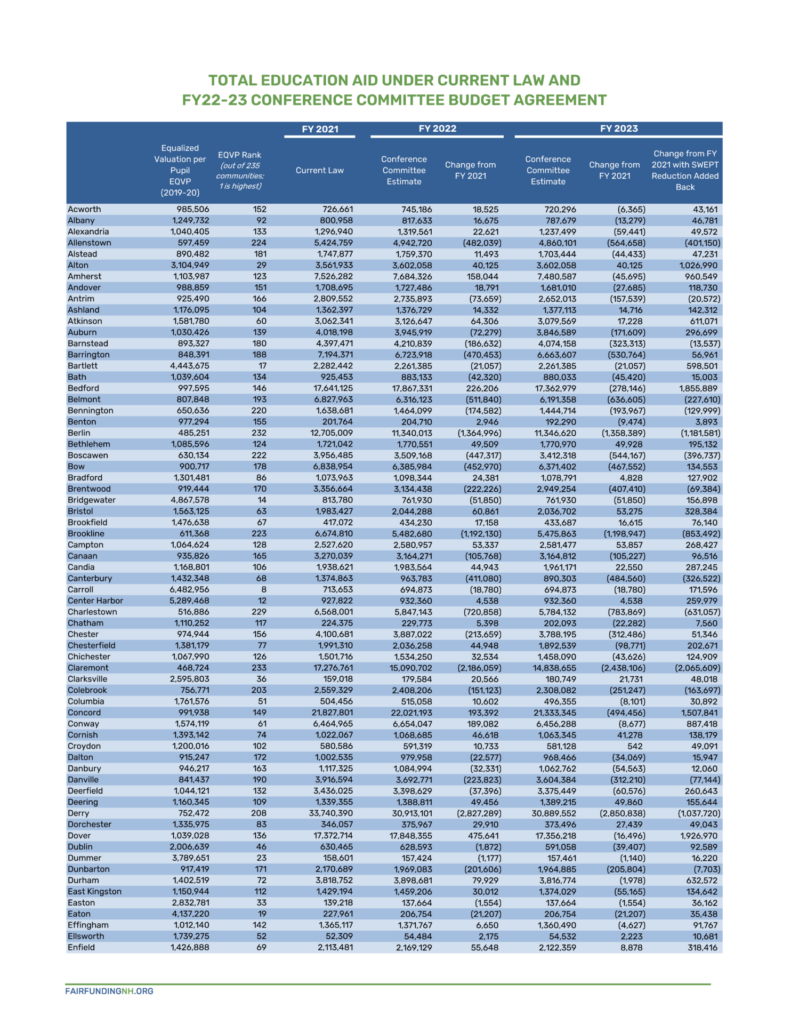
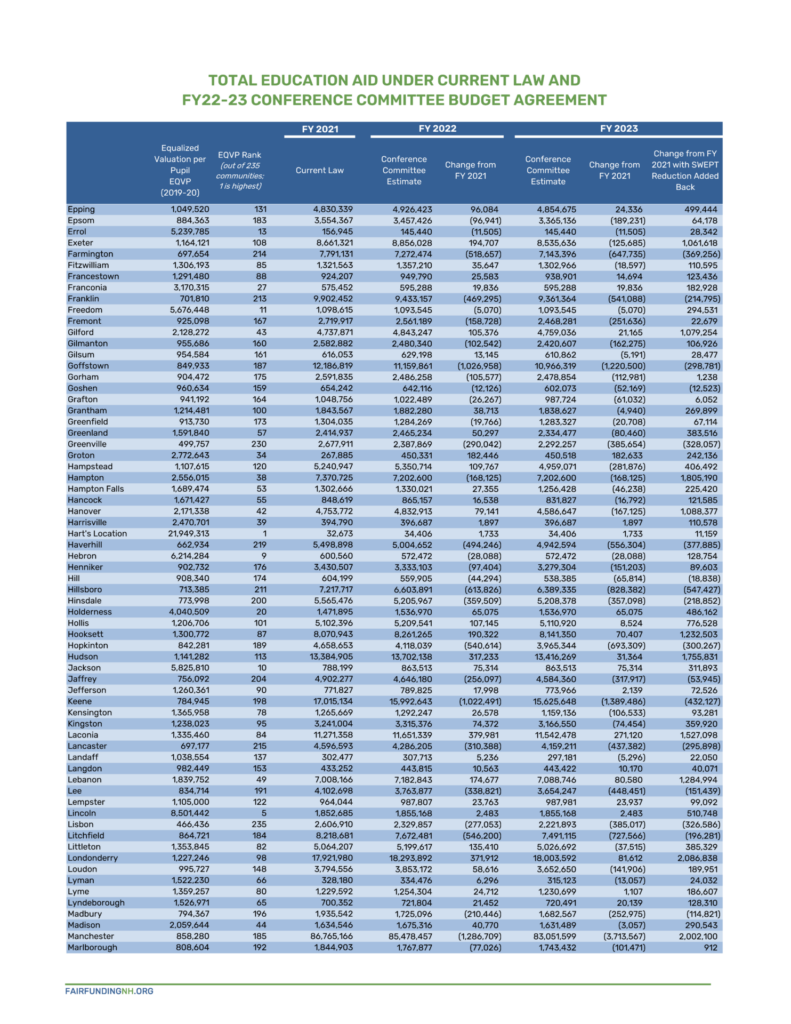
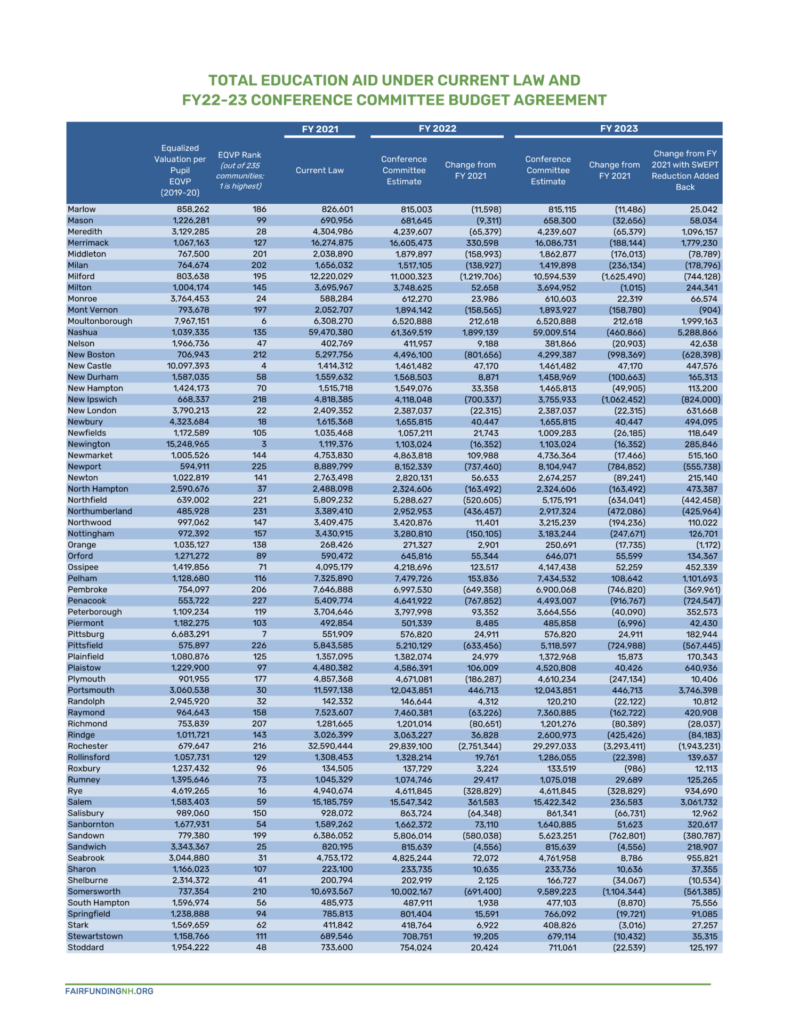
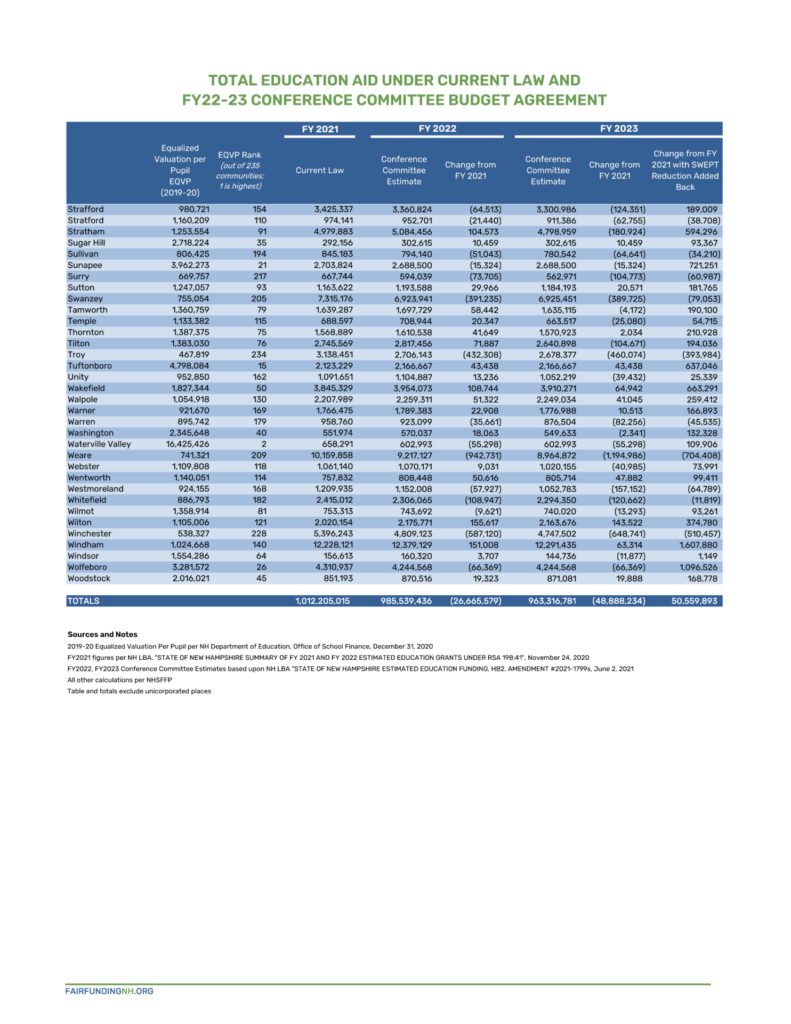
Based on prior estimates from the Office of the Legislative Budget Assistant, total education grants to New Hampshire’s cities and towns (excluding unincorporated places) are expected to reach $1.012 billion in the current fiscal year (FY2021). That sum includes the value of SWEPT raised and retained by those municipalities.
In comparison, under the provisions of the conference agreement on the FY22-23 budget, those grants would fall to $985.5 million in FY 2022, a decline of $26.7 million. By extension, 105 cities and towns – or nearly half of all communities – would lose some aid relative to FY21, as the attached tables indicate. Nine municipalities – including Berlin, Derry, Manchester, and Rochester – would suffer declines of more than $1 million each.
In FY 2023, total education grants are projected to amount to $963.3 million, reflecting the reduction in the SWEPT, including the value of “supplemental payments” noted above, and, again, excluding grants made to unincorporated places. That figure is $48.9 million less than the FY 2021 total, with 170 communities seeing some drop from FY 2021 . Even if one were to assume that communities were to compensate for the loss in state aid by increasing local property taxes by precisely the same amount as their state property tax obligations decline – in other words, by holding their combined state and local school property tax rates steady – just over 60 municipalities would still be worse off in FY 2023 than they are in FY 2021.
All told, 59 cities and towns – or 1 out of every 4 – would receive less in state education aid in both FY 2022 and FY 2023 than they do in FY 2021, even after adding back the value of any SWEPT reduction. Importantly, the overwhelming majority of the municipalities suffering drops in both years have among the lowest property values in the state. In fact, 51 of the 59 communities suffering two years of lower education aid have property values that place them in the lowest quarter of all municipalities. Of those 51, each had an equalized property value, on a per pupil basis, of less than $900,000 during the 2019-2020 school year, compared to the statewide average of just over $1.2 million.
Stated slightly differently, all of the 25 most property poor cities and towns in New Hampshire – places like Lisbon, Charlestown, Allenstown, and Rochester – would receive less in state education in FY22 and FY23 under the legislature’s final budget plan than they do today – and all have property values under $740,000 per pupil. In the case of Allenstown, for instance, it will receive roughly $400,000 less in state education aid in both FY22 and FY23 than it does right now. In response, it will have to increase local property tax rates or force students and educators to make do with less, whether by forgoing needed equipment purchases, expanding classroom sizes, or other short-sighted changes.
In sum, rather than moving New Hampshire closer to creating a funding system that ensures every school has the resources it needs to provide an excellent education, the proposed FY22-23 budget would leave many students and communities further behind.