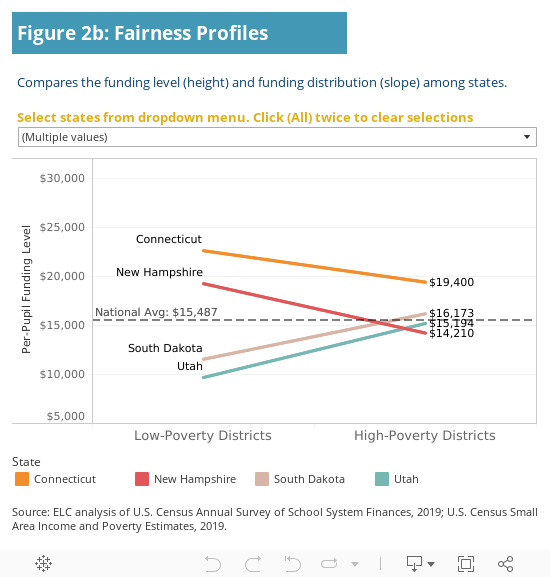
According to the Education Law Center’s recent report Making the Grade 2021, which studies school funding fairness in all 50 states, New Hampshire has the second most regressive school funding structure in the country, earning a grade of F.
A fair school funding system must deliver more funds to those most in need, usually school districts with high concentrations of poverty that require additional resources to serve their students. The ELC report defines a “regressive” school funding structure as one that delivers less money per pupil to high-poverty districts than to low-poverty districts. Overall, ELC calculated that NH spends 26% less (or the equivalent of $5,037 per pupil) on high-poverty students than low-poverty students, the sharpest funding disparity between highest and lowest poverty districts of all 50 states.
New Hampshire earned high marks for its overall funding level (grade A) and funding effort (grade B), as measured by the share of state GDP spent on education. However, these honors come with caveats. While the statewide average per-pupil expenditure is high, and while the state spends a significant portion overall on education, relative to its capacity, the money is woefully absent in the districts that need it most.
While the ELC report does not examine in depth the sources of these disparities among states, in New Hampshire the principal source is clear – the state’s failure to meet its fundamental responsibility to provide an adequate education and the gap that communities must fill as a result.
Any reform to New Hampshire’s school funding system must address not only how the state generates the necessary revenue to meet its responsibility, but also how it is distributed so that districts and students with the greatest challenges receive the funding they need.