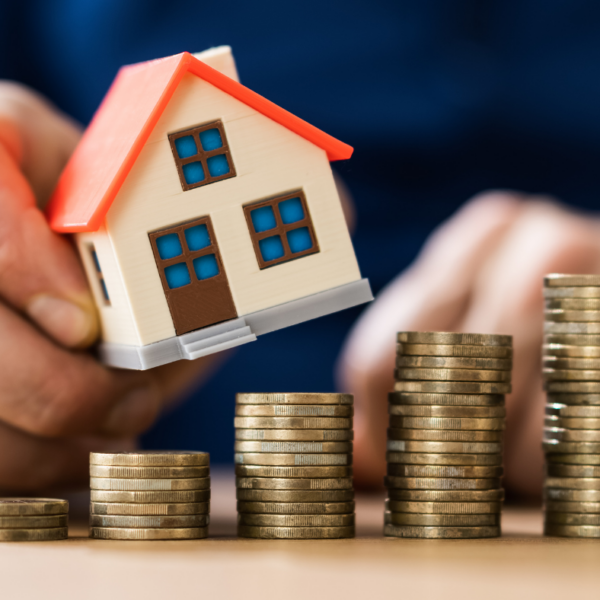
It’s that time of year again – property tax bills are beginning to arrive in homeowners’ mailboxes across New Hampshire. For many, their property tax bill is the single largest bill they’ll pay all year, creating real hardships for families living on fixed- or low-incomes.
In response, some may rail against their assessor’s office or their school or select board, but New Hampshire’s property tax problem isn’t due to local decisions. It stems instead from choices state policymakers have made for decades now.
Simply put, because the State of New Hampshire has, for decades, shirked its obligation to provide and pay for an adequate education for every child, school funding costs are downshifted to local property tax bills. New Hampshire relies more on property taxes than any other state. As a result, families struggling to make ends meet pay a much larger share of their incomes in taxes than the well-to-do.
As the graph below shows, the state share of elementary and secondary school revenue is smaller in New Hampshire than anywhere else in the country. Based on data from the National Center for Education Statistics, during the 2018-2019 school year, various forms of state aid comprised less than 20 percent of total elementary and secondary revenue in New Hampshire. Contrast that with places like Minnesota or Vermont, where the state contributes anywhere from 60 to 90 percent of public school resources.

How does New Hampshire make up the difference? Via the property tax, of course. In fact, New Hampshire counts on the property tax to support state and local public services more than any other state in the nation. Data from the US Census Bureau demonstrate that the property tax made up 64 percent of all state and local tax revenue in New Hampshire in FY 2018, the most recent year for which comparable state by state data are available. That’s more than twice the share for the country as a whole. Even the next highest state – New Jersey – trails New Hampshire’s reliance by almost 20 percentage points.

This over-reliance on property taxes has very real – and very unequal – consequences for Granite State renters and homeowners. More specifically, the nationally-recognized Institute on Taxation and Economic Policy (ITEP) finds that middle-income New Hampshire taxpayers have an average tax rate that more than two and half times higher than that faced by the richest 1 percent.

The main culprit for that disparity? Again, the property tax. ITEP’s estimates show an effective property tax rate amounting to 6.3 percent of income for households with incomes ranging from $45,000 to $72,800, while households with incomes over $514,900 pay property taxes equal to just 1.9 percent of their incomes on average.
What to do about it? Well, New Hampshire’s over-reliance on local property taxes will end only when the state finally owns up to its responsibility to provide an adequate education to every child in the Granite State – a duty its shirked for nearly 30 years – and puts up the financial resources to match. The New Hampshire legislature has considered numerous small scale changes, both good and bad, to our school funding system in recent years – and has even passed some of them – but comprehensive, permanent, and fair reform – that addresses both how state education aid is distributed and how the state generates the resources needed to fulfill its obligations – is what is truly needed.