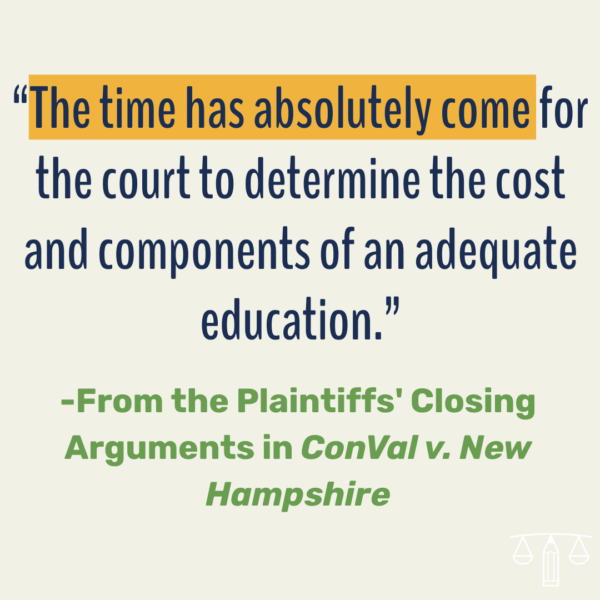
NHSFFP issued the following statement following the conclusion of the trial in the ConVal School District v. State of New Hampshire trial on May 5, 2023.
This afternoon, the trial in the ConVal school funding trial concluded its proceedings with closing arguments from the state and the school district plaintiffs. Over the three weeks in the courtroom, the plaintiffs laid out a clear and compelling case that the State is failing to fulfill its constitutional responsibility to fund education
“You can boil the State’s whole defense down to one thing. They couldn’t defend their low adequacy number, so instead they have tried to discredit the plaintiffs’ attempts to define the cost of an adequate education,” said Zack Sheehan, NHSFFP Executive Director. “The State tried to argue that you can’t take the number that one district comes up with and apply it statewide. But when the Commissioner of the Department of Education says he doesn’t know what adequacy costs and has never even studied it despite his department having all the information it needs to try and figure that out, that argument really doesn’t have a leg to stand on. They also went so far as to argue that despite decades of court rulings followed by legislative inaction and more litigation, now is not the time for the courts to step in.”
The two out-of-state expert witnesses retained by the State also did not address the cost of adequacy, and instead tried to discredit the methods used by the plaintiffs to calculate the cost of an adequate education. One of them even went so far as to suggest that heating a school building was not necessarily required for a constitutionally adequate education.
During their closing statement, the plaintiffs accused the State of acting in bad faith by forcing school districts and their staff to utilize limited time and resources to argue in court. “It took 4 years and hundreds of thousands of dollars to get to this point, and all because the State refuses to uses its own data to determine the cost of an adequate education,” Sheehan said. “The State even spent another $500,000 on the Commission to Study School Funding, which reaffirmed the problem of low state funding and presented several possible solutions. But instead of working toward a solution, the legislature has largely ignored the report.”
The testimony of the many superintendents and school administrators over the course of the trial consistently touched on the realities of operating a school, and the wide array of costs associated with delivering an education that the State does not currently consider to be part of the definition of an adequate education, spanning from light, heat, and other facilities expenses to school nurses and transportation costs. Every single one of them said their schools would not be able to operate if their budget was limited to what the State paid in adequacy.
“Anyone watching could see that the state continues to ignore its constitutional responsibility to fund public education. Schools are simply not getting enough from the State to provide the education that they are required to,” Sheehan said.
On the final day of testimony, the Business Manager for the Newport School District was questioned about a project he did in conjunction with the Newport superintendent and the NH School Funding Fairness Project. The Project has done this exercise in the absurd with several school districts over the years, where we ask them to make hypothetical cuts to their budgets to reduce them to the amount that they receive in adequacy aid from the State.
“Every time we do this exercise with a school district, it is impossible for them to get their budget down to the level of just adequacy funding without making dozens of hypothetical cuts that violate State law, Federal law, and just plain common sense,” Sheehan said. “We did one recently with Allenstown where they realized they wouldn’t be able to afford to tuition their high school students anywhere. An education in Allenstown, funded just by adequacy, would end in the 8th grade which is ridiculous. That’s clearly not enough funding.”
This case had been previously ruled on by Judge David Ruoff in 2019, and following appeals to the NH Supreme Court was remanded so that a trial could be held to determine the cost and content of an adequate education. Judge Ruoff took the matter under advisement at the conclusion of today’s arguments. Regardless of the outcome and content of his ruling, there is likely to be further appeals to the NH Supreme Court.
“The plaintiffs have been compelling and consistent in their argument that the State does not provide enough funding to support an adequate education, and we believe that the State’s lack of positive arguments in support of the current adequacy amount makes this pretty clear cut,” Sheehan said. “With another school funding trial set to begin in September, I think this should highlight to everyone in the State Legislature how important it is that they start taking the need for school funding reform seriously, and use the state budget as a vehicle to begin working toward a solution that treats all students and taxpayers fairly.”