Citations
1 https://reachinghighernh.org/2023/11/07/as-school-voucher-program-cost-surpasses-22-million-this-year-state-oversight-committee-raises-questions-about-transparency-and-diversion-of-public-funds/
2 https://www.education.nh.gov/news/nhed-releases-603-bright-futures-survey-results-0
Fast Facts
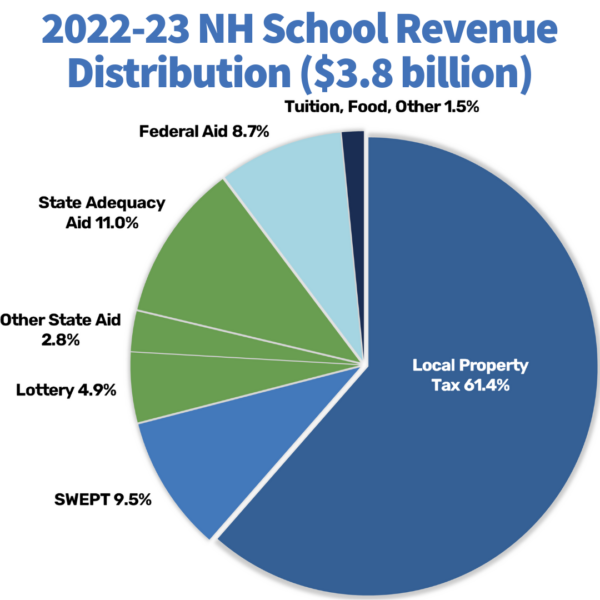
- For the 2022-23 School Year, the total revenue of NH School Districts was $3.8 billion. According to the most recent data from the Department of Revenue Administration, 61.4% of all revenue for public schools in New Hampshire came from property taxes. If you add the 9.5% that came from the Statewide Education Property Tax (SWEPT), the total property tax share of public school revenue was $2,699,648,577. Since SWEPT is raised and retained locally, it does not act as a state tax and is therefore just another local property tax.
- This year, school vouchers will divert $25 million in taxpayer dollars from public schools, with little accountability or oversight over the program.
Educator workforce shortage data
- The starting salary of a new teacher in NH is $40,478, much less than $56,727 per year, the average cost of living in the state. (Source: Report from the Legislative Study Committee on Teacher Recruitment and Retention, 2023)
- The teacher shortage is real and is motivated by several factors. Top concerns are stress/burnout, student behavior and discipline, school culture, and low salaries. In 2022, the number of teachers was lower than in 2010, but the continued to increase into 2023. (Source: Report from the Legislative Study Committee on Teacher Recruitment and Retention, 2023)
Graduation and post-grad data
- Overall, New Hampshire’s high school graduation rate is approaching 90%, but gaps remain for students experiencing poverty (73%), students with disabilities (73%), and multilingual students learning English (69%).
- College enrollment rates have dropped substantially since the pandemic: overall college enrollment has dropped 8 percentage points among all students, from 63% of high school graduates in 2020 to 55% of high school graduates in 2023.
- In 2023, approximately 55% of New Hampshire graduates enrolled in college after graduation. College enrollment rates are significantly lower for students experiencing poverty (31%), students with disabilities (27%), and multilingual students learning English (28%).