We often throw around the acronym “SWEPT”, which is short for the Statewide Education Property Tax. But while it should be a straightforward tax raising money to fulfil the State’s duty to fund an adequate education, in reality it is more complicated than that.
History of SWEPT
SWEPT is one of the major funding sources for NH public schools, generating $363 million each year, or 9.5% of all school revenue.
The State Legislature created SWEPT in the aftermath of the Claremont rulings to help generate the funds for the newly established “adequacy aid” that was going to pay for the cost of an adequate education.
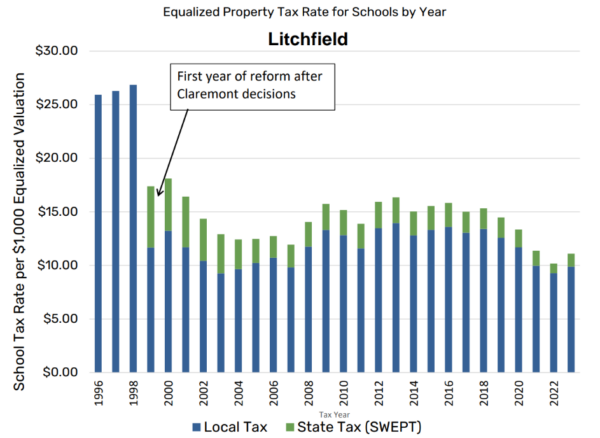
Even with the introduction of this new property tax, the average property tax payer in New Hampshire had their education rate fall from $17.68 per $1,000 to $13.26 (local and SWEPT combined) because the State was contributing funds to their schools. Here is Litchfield, as an example.
SWEPT was born from the Claremont principles that the State had s a responsibility to fund education with taxes that are “uniform in rate.” But in the years since its introduction, that has changed, to the point where SWEPT actually violates that principle.
What is Excess SWEPT?
Every property owner in the state is supposed to pay SWEPT to support the State’s constitutional responsibility to fund education. But, for the last decade the State has been allowing certain property owners to unfairly and unconstitutionally avoid paying SWEPT in part or in its entirety.
The way SWEPT was originally intended to work was for the State to collect all of the money from municipalities and then pay it out to districts based on the adequacy formula. But in 2011, a group of property wealthy municipalities lobbied the State legislature to change that. These towns raised more with SWEPT than the State paid them in adequacy, and they did not want to pay their excess revenue to the State.
Somehow, they got the legislature to agree, and now these places retain their “excess” SWEPT revenues and put them towards educational costs in their districts. That allows them to lower their local education tax rate, and means they are paying a lower effective rate than everyone else in the state.
This is one of the main issues raised by the plaintiffs in the Rand lawsuit. The taxpayers who filed the Rand suit live in communities that do not collect excess SWEPT, and argue that they are not being taxed fairly when property owners in these “excess” municipalities are not paying the full SWEPT rate.
A group of 26 property wealthy communities called the Coalition Communities 2.0 intervened in the case because it is in their interest for excess SWEPT to be allowed to continue. At the NH Supreme Court, the lawyer for this group argued that the State Legislature had made a spending decision to allow these communities to retain and spend their excess SWEPT revenue. But if that were true, that would mean the State Legislature intentionally allocated some of its limited school aid to some of the communities that have the easiest time raising money for their schools.
Excess SWEPT also creates another strange loophole that allows some property owners to not pay the full SWEPT rate.
The NH Supreme Court ruled on June 10, 2025, that retaining excess SWEPT was not unconstitutional. Justice Bassett wrote in his dissent that:
“The majority looks past the fundamental economic reality that money is fungible, and that when communities retain excess SWEPT revenue, the local education tax rate is reduced — and the overall property tax burden for the taxpayers in those communities is likewise reduced. The “effective rate” of the SWEPT is therefore reduced. That, of course, is the purpose — and “practical effect” — of the scheme. And that is why the SWEPT scheme is untenable and violates Part II, Article 5.”
Negative Tax Rates?
Municipalities no longer having to remit their excess SWEPT to the State has created another SWEPT avoidance strategy.
When excess SWEPT stopped being sent to the State, very small municipalities, mainly in the North Country, that don’t have any children living there were faced with an issue. SWEPT revenues, including excess SWEPT revenues, must be spent on educational expenses. Since these places have no children that need educating, they would need to put the SWEPT money in a special account for the possibility of a future student.
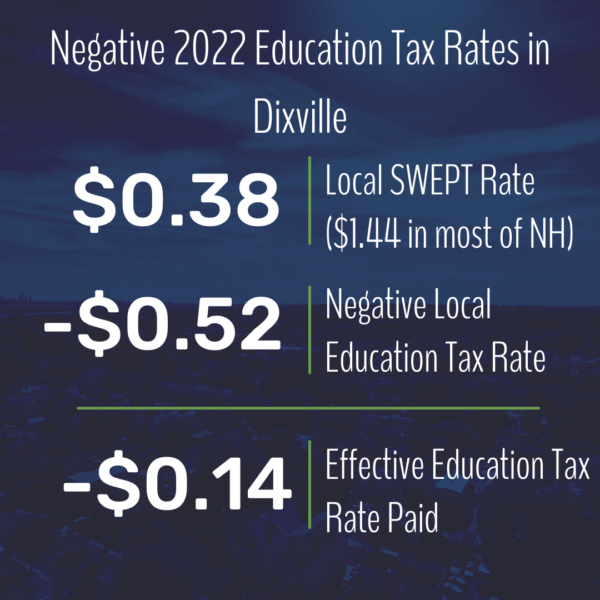
Instead, what these places have done is set negative local education tax rates to offset what they would pay in SWEPT. The State Department of Revenue Administration approves these negative rates, and so these property owners contribute no money to the education of NH students. There is $171 million worth of property in these places that paid $0 towards the education of New Hampshire students.
During the oral arguments of the Rand case, the justices on the NH Supreme Court seemed very skeptical of the idea that some property owners could be totally exempted from what is obviously meant to be a statewide tax.
In the 2023 Superior Court decision finding these SWEPT avoidance tactics unconstitutional that was appealed, the Superior Court wrote “As the Supreme Court has repeatedly emphasized, the public education system benefits the entire State, not merely those communities in which publicly-educated children reside.”
The NH Supreme Court did uphold the ruling that negative local tax rates to avoid paying SWEPT were unconstitutional in its June 10 decision.
SWEPT was meant to have the entire State supporting education, as the Claremont decisions called for. But in reality, not everyone has been paying their fair share.