
Low and Moderate Income Property Tax Relief Program
By Carly Prescott, December 2024
The only current state-level property tax relief program in New Hampshire is the Low and Moderate Income Property Tax Relief Program (LMIPTRP), which offers eligible homeowners a Statewide Education Property Tax (SWEPT) rebate if their household income falls below specific thresholds. Notably, a bill related to this program has been filed for the 2025 legislative session, signaling potential changes or expansion soon. For singles, the income limit is $65,000, while for married individuals or heads of households, it is $77,500. The program provides a maximum tax relief of $1,100 per homeowner, helping to ease the financial burden of property taxes
Key Findings:
- The program is available to homeowners earning less than $65,000 (single) or $77,500 (married/heads of household), with a maximum relief of $1,100.
- Only $1,141,687.41 was allocated for tax relief in 2023, covering 5,650 claims annually.
- Average relief per applicant peaked at $241.08 in 2021, dropped to $156.92 in 2022, and rebounded to $201.66 in 2023.
- Relief offsets only a small portion of the Statewide Education Property Tax (SWEPT), a fraction of most homeowners’ total property taxes. An estimated SWEPT payment for an eligible taxpayer is $426.02, and a total education tax bill (SWEPT plus local) is upwards of $4,663.
- Nashua, Manchester, Berlin, and Derry had the highest number of claims in 2023, reflecting their larger populations. Towns like Warren, Stark, Pittsburg, Gilsum, and Milan had the highest claims per 1,000 residents.
- Towns with populations under 3,000 showed significantly higher claims per 1,000 residents, highlighting the program’s concentrated impact in rural areas.
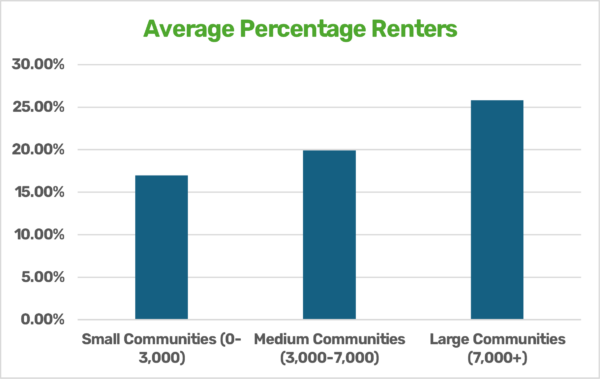
- Larger towns and cities have fewer claims per 1,000 residents, likely due to a higher proportion of renters who are not eligible for the program.
- Broadening eligibility, increasing relief amounts, or extending the program to include local property taxes could provide more meaningful assistance to New Hampshire residents.
Who Claimed These Benefits?
According to the Department of Revenue Administration’s report, only 131 New Hampshire towns reported more than 10 claims. LMIPTRP saw fluctuations in claims and average relief amounts over recent years. From 2021 to 2023, total claims ranged from 10,814 to 11,228 annually, with the average relief per applicant varying, peaking at $241.08 in 2021 and dropping to $156.92 in 2022 before rebounding to $201.66 in 2023. While Nashua, Manchester, Berlin, and Derry had the highest total claims in 2023—unsurprising given their relatively large population, these numbers do not necessarily reflect the highest claims per 1,000 residents.
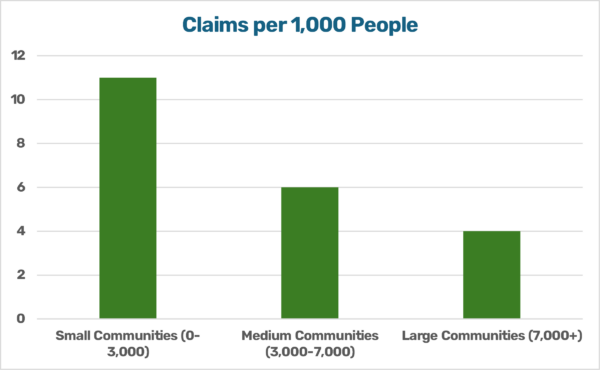
The data highlights that small communities (populations between 0–3,000) have significantly higher claims per 1,000 residents compared to medium (3,000–7,000) and large communities (7,000+). This indicates that, while larger towns like Nashua and Manchester had the most claims overall due to their size, the program has a more concentrated impact in smaller towns, benefiting a larger proportion of their populations.
One reason for the lower claims per 1,000 residents in larger communities is the higher percentage of renters, who are not eligible for the program. The average percentage of renters in a community, derived from the American Community Survey (ACS)[1], provides valuable insight but has limitations in accurately representing smaller towns due to smaller sample sizes. It’s important to consider these limitations when interpreting the findings.
The towns with the highest claims per 1,000 residents—Warren, Stark, Pittsburg, Gilsum, and Milan—highlight a stark contrast with larger communities, suggesting the program’s greater relative impact in smaller, rural areas
How Much Relief is Granted?
Only $1,141,687.41 was allocated to New Hampshire’s LMIPTRP in 2023. This modest expenditure raises important questions about the program’s scale and reach. How can it be expanded to better support eligible homeowners?
The average SWEPT bill in New Hampshire for 2023, based on a rate of $1.11 per $1,000 of property value and an average home value of $479,752, is approximately $532.52.
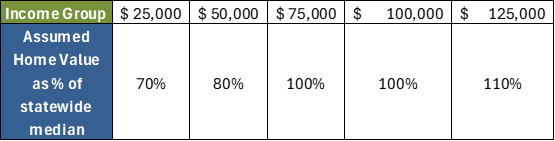 For individuals eligible for the Low and Moderate Income Property Tax Relief Program, homes are typically valued between 80% and 100% of the median, as estimated by the Institute on Taxation and Economic Policy (ITEP). This means their average property value would be a bit lower, around $383,801, resulting in a lower SWEPT bill, closer to $426.02 at the 2023 rate of $1.11 per $1,000 of property value. Meaning, that folks who received rebates received a little less than 50% of their SWEPT bills on average.
The relief provided under the program is modest, especially considering that it only offsets a portion of the SWEPT, which itself represents a relatively small fraction of the total property tax bill for most homeowners. The average Local Education Property Tax in New Hampshire is 8.61. Assuming the same home value, folks eligible for the program could pay upwards of $4,663 on education property taxes.
If everyone who applied for the program received the maximum benefit, it would have cost the state just $5,436,200, approximately 1.5% of the $363 million collected by SWEPT annually.
LMIPTRP offers valuable support to many eligible homeowners, helping to ease the burden of SWEPT. However, given the modest relief amounts and the fact that SWEPT represents only a small portion of the overall property tax bill, there is significant potential to expand the program. Broadening eligibility, increasing relief amounts, or extending the program to include local property taxes could provide meaningful assistance to more residents and address a larger share of the property tax burden.
Download a Copy of this Report
[1] U.S. Census Bureau. (2022). American Community Survey 5-Year Estimates, Tenure by Occupancy Status [Data file]. Retrieved from data.census.gov