Legislation
SB 659 and HB 1815 Move Forward Despite Overwhelming Public Opposition
Mar 19, 2026
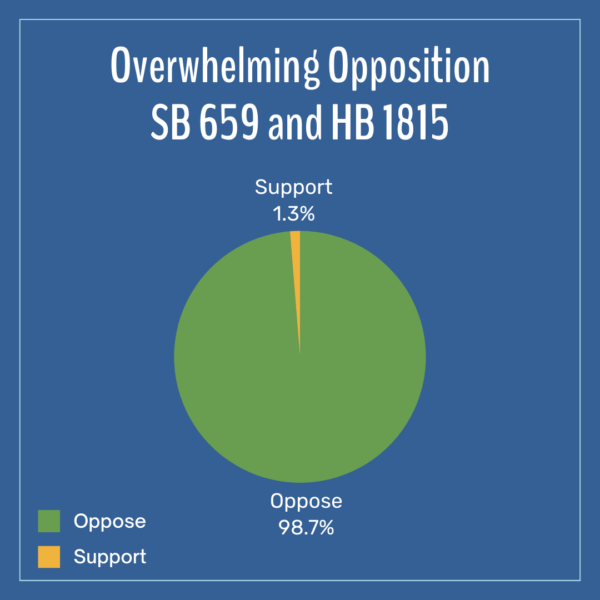
Last Friday, March 13, for more than four hours, people from across New Hampshire showed up at the State House to testify on SB 659 and HB 1815. Everyone except the bill sponsors gave articulate, detailed testimony about why the bills are not wanted in New Hampshire.
Parents, educators, school board members, administrators, taxpayers, and others made time on a workday to be in Concord at 9:00AM. Many arranged childcare, took time off from work, and prepared testimony, some for the first time, to speak directly to the lawmakers elected to represent them.
More than 1,500 people signed in online in opposition to the bills. The message, across that testimony, was clear and consistent: Granite Staters are asking for meaningful property tax relief and real funding solutions for their public schools. These bills do not address either challenge.
Instead, as several people testified, they change the framework of responsibility without solving the underlying problem.
“These bills do not reduce reliance on property taxes… and they do not provide any property tax relief at all.” -Richard DeMark
“Instead of addressing the underlying problem, SB 659 and HB 1815 attempt to rewrite the law.” -Dan LeGallo
SB 659 and HB 1815 do not increase state funding for public education; they do not lower property taxes or our dependency on them; and they do not determine what an adequate education actually costs. What they do is redefine how responsibility for that cost is described in state law, at the same moment courts have ruled that the current system is not meeting the State’s constitutional obligation. These are impacts communities are already experiencing, and that many parents and local officials described directly in their testimony.
After more than four hours of public testimony, the hearing concluded and the Senate Education Finance Committee moved into executive session. Less than ten minutes later, both bills were advanced on a 3–2 vote, down party lines.
There was little discussion. No visible engagement with the testimony that had just been delivered. No acknowledgment of the scale or consistency of public opposition. The outcome was determined almost immediately. One senator, after introducing the bill, simply left the room and didn’t listen to any of the testimony, and just came back at the end to vote in favor of it.
For many who were in the room, or watching from home, that sequence was difficult to reconcile. If hours of testimony, delivered by constituents and experts from across the state, do not appear to factor into the outcome, or at least provide reason for a meaningful discussion, what role is that testimony meant to play?
The testimony was not abstract. It reflected lived experiences from communities across New Hampshire. People spoke about rising property taxes, strained school budgets, and the challenge of maintaining programs and services for students.
“People across New Hampshire are asking for meaningful property tax relief… This bill does not address those concerns—it actively ignores them.” -Sinehan Kerman
“When the state’s commitment becomes unclear, local taxpayers are going to end up filling the gap.” -Sarah Gentile
“This bill accomplishes nothing… it is a transparent attempt to further delay the much-needed reform of school funding.” -James Moyer
Across testimony, a common question emerged: If these bills do not lower property taxes, do not increase school funding, and do not clarify the State’s responsibility, what problem are they solving?
This hearing and these pieces of legislation are not happening in isolation. At the same time these bills are moving through the Legislature, the State has formally asked the New Hampshire Supreme Court to overturn the Claremont decisions, representing three decades of precedent establishing the State’s constitutional responsibility to define, fund, and ensure an adequate education.
Alongside that legal effort, HB 1815 and SB 659 would rewrite key sections of the statutes those rulings rely on. They remove language guaranteeing students an opportunity for an adequate education and reframe education as a system of “shared responsibility” without defining the State’s share. Instead of addressing the funding gap identified by the courts, these bills attempt to change the definition of responsibility. Taken together, these developments point in a consistent direction: not toward resolving the underlying challenges in school funding, but toward redefining them.
Constituents Are Weary, and Wary, of the Legislative Process
New Hampshire’s “citizen legislature” is built on the idea that public participation matters; that showing up, speaking out, and engaging in the process can shape decisions.
Last Friday, people did exactly that. They showed up. They prepared. They spoke clearly and respectfully about issues affecting their communities. And yet, the outcome did not appear to reflect that input. That disconnect is what many people are responding to now.
Showing up matters, and it continues to shape how this issue is understood across the state. But frustration is mounting as people question whether that participation is being reflected in legislative decision-making.
What Happens Next
SB 659 is going to the Senate floor for a vote on Thursday, March 26.
In the meantime, we are hearing from people across New Hampshire who are asking the same question:
What does it mean to participate in the legislative process when the outcome feels predetermined?
We are collecting those responses.
Whether you were in the room, following along, or learning about this now, you can share your reaction. Your message can be as simple as how you felt watching hours of testimony followed by a rapid vote with little discussion.
You can write about why public education matters to you, or about property taxes in your community. You can write about whether you feel your voice, and the voice of your community, is being heard.
What matters is that it is your voice.
We will compile these messages and deliver them to your Senators ahead of next week’s vote. Legislators are elected to represent their constituents. Many Granite Staters are asking to be heard in that process.
Coverage of the hearing reflected what many in the room experienced: extended public testimony, overwhelmingly in opposition, followed by a swift committee vote.
Further analysis of Friday’s hearings helps to connect this legislation to “increased property taxes in the least wealthy communities, fewer educational offerings, and, ultimately, poorer outcomes for students and for the state.”
Reporting on the Court appeal process connects SB 659 and HB 1815 to the Legislature’s intent to ignore and reverse 30 years of precedent, and the majority’s party back-handed tactics to undermine the authority of the courts.