News
HB 751 Dies as Statewide Open Enrollment Proposal Fails
Jun 4, 2026
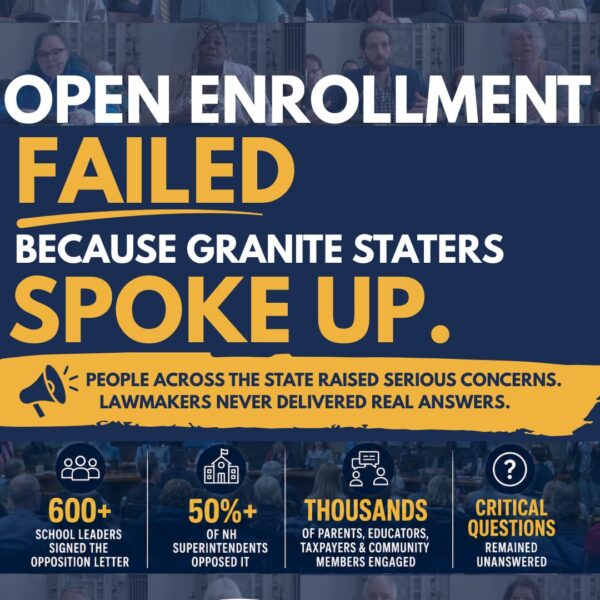
June 4: Today the New Hampshire School Funding Fairness Project released the following statement after HB 751, a major priority of legislators in Concord to advance statewide open enrollment legislation, failed to pass before the end of the 2026 legislative session.
While the final days of debate focused on last-minute negotiations and disagreement among state leaders, the larger story is clear: HB 751 failed because people across New Hampshire spent months raising serious, specific, and unresolved concerns about how the policy would work in practice. Governor Kelly Ayotte’s own comments reinforced that point, noting that more work was needed outside of Concord and that feedback from school districts helped shape her view that the bill was not ready.
“HB 751 did not fail because of one moment at the end of session,” said Zack Sheehan, Executive Director of the New Hampshire School Funding Fairness Project. “It failed because people across the state refused to let a major education policy be rushed through without answers. School board members, superintendents, educators, parents, and community members showed up again and again to explain that this proposal was not ready and would create real risks for students, districts, and taxpayers.”
Earlier this session, after lawmakers attempted to suddenly advance sweeping statewide open enrollment legislation, school board members and district leaders across New Hampshire organized quickly. Within 72 hours, more than 600 school board members and school administrators, including more than half of the state’s superintendents signed an open letter opposing the rushed advancement of the legislation.
The letter warned that statewide open enrollment could destabilize the public education system that serves roughly 90% of New Hampshire students and families. It raised concerns about new tuition obligations for sending districts, the impact on students who remain, transportation barriers, special education compliance, and the absence of meaningful state funding to absorb the financial risk created by student movement.
Alongside the letter, school leaders and advocates developed a growing list of unanswered questions about how statewide open enrollment would work in practice. That list quickly grew to more than five pages as local officials added concerns in real time.
“From the beginning, the people responsible for making schools work every day were asking critical questions,” Sheehan said. “Who pays when students transfer? What happens after local budgets have already been approved? How are special education services delivered and billed? What happens to students who cannot provide their own transportation? What happens to the students who stay in districts that lose revenue but cannot immediately reduce costs? Those questions were never fully answered.”
Over the course of the session, lawmakers repeatedly changed the proposal, including major revisions to the funding mechanism and later attempts to limit participation. But each version raised new questions and left the core issue unresolved – the fact that NH provides the smallest share of public school funding out of any state in the country. This reality, and refusal of lawmakers to seriously address it, means that the open enrollment proposals each would have had wildly varying impacts on local schools and property tax payers.
HB 751 would have required school districts to pay tuition for at least 10% of their students to attend school in another district, even in communities where local voters recently chose to limit those transfers. Just this past spring, more than 140 towns voted on local open enrollment policies. In many communities, voters chose to allow out-of-district students to enroll while limiting the number of resident students who could leave at local taxpayer expense. HB 751 would have overridden all of those local decisions.
“Local voters already made decisions about open enrollment this year,” Sheehan said. “HB 751 would have erased those decisions and replaced them with a statewide mandate that shifted new financial risk onto local communities. That is not local control.”
NHSFFP emphasized that today’s outcome should not be treated as the end of the conversation. Current open enrollment law has real flaws and deserves serious review. Any future proposal should be developed through a careful, transparent process that begins with school districts, families, taxpayers, students, educators, local officials, and the communities responsible for implementing the policy.
“New Hampshire needs a better conversation about open enrollment,” Sheehan said. “The lesson from this session is that major education policy cannot be written behind closed doors, rewritten at the last minute, and imposed on communities without answers. The people who spoke up over the past four months made the difference, and they showed exactly why public process matters.”