News
Strong Schools, Affordable Communities
Aug 7, 2026
_________________
Across New Hampshire, communities are feeling increasing pressure.
Residents are grappling with rising property tax bills at the same time that school districts are navigating declining student enrollment, reducing staff, delaying investments, and struggling to maintain programs and services. Conversations about local budgets have become more difficult, and communities that care deeply about their public schools often find themselves divided over how to pay for them.
At first glance, rising property tax bills alongside school district cuts can seem contradictory.
State leaders frequently point out that education spending is at record levels, and that New Hampshire remains a relatively low-tax state. Yet many residents describe a very different experience. Property taxes continue to rise. School districts are facing difficult budget decisions. Communities across the state are wrestling with questions of affordability, sustainability, and what they can realistically support moving forward.
Understanding that disconnect requires us to ask a different question:
Who is paying for public education?
For years, New Hampshire’s school funding debate has been framed as a conflict between taxpayers and public schools. But that framing misses something important. Across the state, both taxpayers and public schools are struggling under a system that relies heavily on local property taxes to fund what is ultimately a statewide responsibility.
When we look closely at how public education is funded in New Hampshire, a different picture begins to emerge.
Following the Money
It is true that public education costs more today than it did fifteen years ago.
That should not be surprising. The cost of transportation, utilities, healthcare, building maintenance, technology, and personnel has increased over time. School districts, like families and businesses, are operating in a very different economic environment than they were fifteen years ago.
But focusing only on dollar amounts without context can obscure a more important question. The issue is not simply whether education costs have increased. The issue is who has been expected to bear those costs.
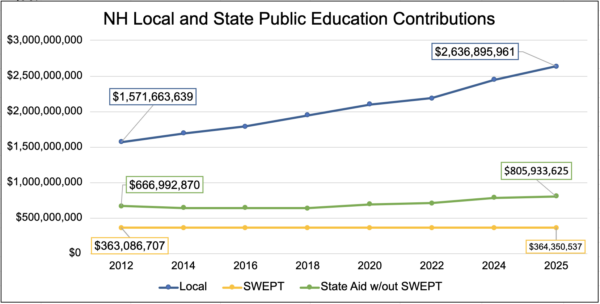
Data from the New Hampshire Department of Education reveal a clear pattern. While education costs have continued to rise, local property taxpayers have taken on an increasing share as the state’s contribution has failed to keep pace.
Since 2012, the state’s contribution, including SWEPT, has grown by about $140 million, while local property taxpayers have taken on an additional $1.07 billion. The contrast is even clearer in percentage terms: state funding increased by just 14%, compared with a 68% increase in local contributions. Over the same period, inflation rose by roughly 40%, meaning the state’s contribution did not even keep pace with rising costs.
This graph has been used to argue that education costs are rising too quickly or that state funding is already sufficient. But its clearest message is not simply how much is being spent. It is who has been expected to bear the increase.
That distinction matters because many of the costs associated with public education do not decline in proportion to enrollment. School districts must still transport students, maintain facilities, provide special education services, and hire qualified educators, even as these essential services become increasingly expensive.
Over time, local communities have been expected to shoulder more of those costs. That trend is particularly significant in New Hampshire, where public education depends more heavily on local property taxes than in any other state. When state funding fails to keep pace with rising costs, the difference is often felt directly in local budgets and local tax bills.
What Happens When the State Doesn’t Keep Up?
The consequences of this shift are increasingly visible in communities across New Hampshire.
Residents who care deeply about their local schools are finding themselves in difficult budget conversations because they are simultaneously confronting rising housing costs, rising healthcare costs, and rising property tax bills. School districts are facing pressure to reduce programs and staffing even as many of their costs continue to increase. What emerges is not simply a debate about school spending, but a broader tension between maintaining strong public institutions and preserving affordability within local communities.
This tension is not the result of a lack of community support for public education.
Communities across the state care deeply about their public schools, which nearly nine out of ten New Hampshire students attend. Residents understand the role schools play in preparing students, strengthening communities, supporting local economies, and creating opportunities for future generations.
At the same time, many of those same residents are worried about whether they can continue to afford to live in the communities they call home.
These concerns are not mutually exclusive.
People should not have to choose between supporting strong public schools and remaining in their homes. Yet as state support has failed to keep pace, communities increasingly find themselves confronting exactly that tension.
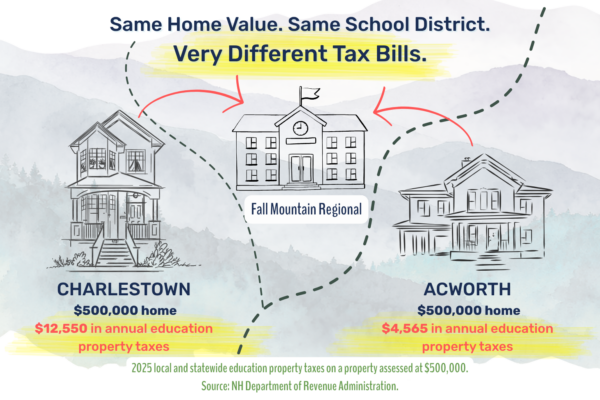
The challenge is especially visible in communities with limited property wealth. Because property values vary dramatically across New Hampshire, different communities have very different capacities to raise revenue through local taxation. Some communities can generate substantial revenue with relatively modest tax rates, while others must impose significantly higher tax rates to raise far less. For example, the owner of a home valued at $500,000 in Charlestown would pay $12,550 in combined local and state education property taxes. In neighboring Acworth, which is part of the same school district, the owner of a home of the same value would pay $4,565. Charlestown’s combined education property tax rate is $25.10 per $1,000 of property value, compared with $9.13 in Acworth.
When we talk about school funding, we often talk about dollars and cents. But beneath those numbers is a larger fact about opportunity, capacity, and how state policy is forcing communities to carry responsibilities they cannot reasonably shoulder on their own.
The Cost of Division
One of the less visible consequences of New Hampshire’s funding system is the strain it can place on community relationships.
Because local property taxes are the primary mechanism for funding public education, many statewide challenges are transformed into local conflicts. Residents understandably look for explanations for rising tax bills. School boards are asked to balance increasingly difficult budgets. Districts face growing scrutiny, while much of the public conversation remains focused on cutting programs and positions at the local level.
Over time, conversations that should be focused on shared challenges can become focused on assigning blame.
Parents and retirees are often portrayed as having competing interests. Taxpayers and educators are frequently placed on opposite sides of public debates. Communities are encouraged to scrutinize smaller, local spending decisions instead of examining the larger system that produced those pressures in the first place.
Yet when we step back, most people are asking for the same things.
They want strong schools.
They want affordable communities.
They want opportunities for children.
And they want confidence that public resources are being managed responsibly.
The challenge is that our current funding structure increasingly forces these goals into competition with one another, while state policymakers have yet to advance solutions capable of sustaining both.
These Challenges Can Be Addressed
New Hampshire has grappled with these questions before.
The Claremont decisions in the ‘90s established two important constitutional principles: the State has a responsibility to provide and fund an adequate education for every child, and the taxes used to do so must be uniform across the state. At the heart of those decisions was a recognition that educational opportunity should not depend entirely on the property wealth of the community where a student happens to live.
The creation of the Statewide Education Property Tax, commonly known as SWEPT, was one response to that challenge.
Like any public policy, SWEPT has evolved over time and remains the subject of ongoing debate. But its underlying premise reflected a broader idea: since public education is a statewide responsibility, it requires meaningful and intentional statewide investment.
That history is worth revisiting because it challenges some common assumptions about taxation and public investment.
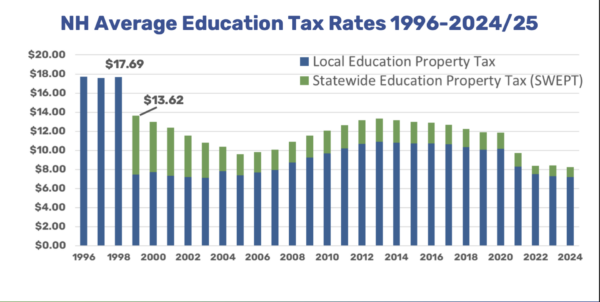
When SWEPT was first implemented, average education property tax rates declined statewide, from $17.69 per $1,000 of property value in 1998 to $13.62. That is because this new tax was paired with additional support from the state, and the increased funding was weighted towards communities with lower property values, high taxes, and higher levels of need. In other words, the goal was to direct funding to help reduce communities struggling the most. Many communities that received additional state funding passed significant savings on to local property taxpayers, contributing to a decline in average education property tax rates statewide.
Source: NH Department of Revenue Administration
The lesson is not that any particular policy was perfect. Rather, it is that how we raise revenue and share responsibility has profound consequences for taxpayers, students, and communities alike. Not every tax or revenue policy increases costs for every taxpayer. When the goal is to reduce pressure on people and communities struggling with high property taxes, policy choices can be designed to do exactly that. Yet over the past decade, state policy has continued to shift a disproportionate share of education costs onto local communities.
Looking Ahead
The questions facing New Hampshire today are not fundamentally about whether public education is important. Communities across the state answer that question every day through the support they continue to show for their local schools.
The more difficult question is whether state leaders and policymakers are willing to pursue solutions that better serve students, taxpayers, and communities alike.
The State can build a system that allows people to support strong public schools while also preserving affordability.
The State can reduce pressure on local property taxpayers without diminishing educational opportunities.
The State can create a funding structure that recognizes public education as both a local institution and a statewide responsibility.
These questions do not have simple answers. But they point us toward a broader conversation about the future of our communities and our state.
Public education is an investment. It is an investment in children, in local economies, in civic life, and in the future of New Hampshire itself.
The challenge before us is not choosing between strong schools and affordable communities.
The challenge is finding the will to build a funding system capable of sustaining both.