We talk a lot about an “adequate” education, and “adequacy” aid. But how does adequacy aid work, and where did it come from?
Why "Adequate"?
We use the word “adequate” so much because it is the word used by the NH Supreme Court in the Claremont decision of the 1990s. In those decisions, the Court interpreted Part II, Article 83 of the NH State Constitution as enshrining a right to an “adequate education”, and that to ensure that right, the State had a responsibility to pay for that adequate education.

But what does “adequate” mean? The Court ordered the State Legislature to come up with a definition, but did provide some guidance in their decisions about what they thought an adequate education should entail. The justices envisioned and expansive and well-rounded education that would give NH students the skills they needed to participate in the local and global economies.
As a result of these court rulings, the legislature got to work, and created a brand new source of State education funding, which they called “adequacy aid.”
How Does Adequacy Aid Work?
Adequacy aid is the main form of education funding that local school districts get from the State, with the money being sent to school districts determined by a student based formula.
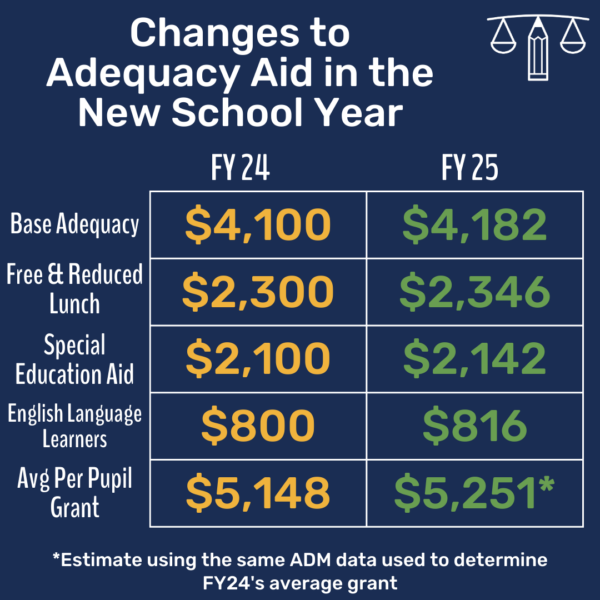 For the current, 2024-25 school year, the State pays a “base adequacy” amount for every single student enrolled in a school of $4,182.
Then there are 3 categories of what the State calls “differentiated aid”. The State pays additional money for these categories of students because they need more resources than other students for their education.
The State contributes an additional $2,346 for every student eligible for free or reduced price lunch. This is not to pay for the student’s lunch, the State uses eligibility to measure poverty, and has determined those students need additional resources.
Then the State pays $2,142 for every student with an Individualized Education Program (IEP) who is receiving special education services. The actual additional cost of these services was $29,556 per pupil in 2023, and are mandated by State and Federal law.
Lastly, the State pays $816 for every student in an English Language Learner program.
If you put all these together, the average adequacy aid the State pays per pupil is expected to be about $5,251 this school year (an estimate, since the NH DOE finalizing adequacy grant amounts in the spring).
During the 2023-24 school year, the actual average cost of educating a NH student was $21,545.
Is Adequacy Aid Actually Adequate?
The amount the State pays in adequacy aid falls far short of the actual cost of education. That is because the State has a very narrow definition of adequacy that does not reflect the real world costs of running a school.
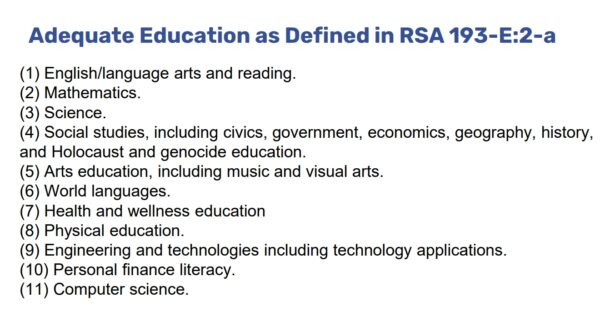
The State currently defines an adequate education as 11 subject areas, and only considers costs directly related to the teaching of those subject areas as part of an adequate education.
But would a school district actually be able to provide students with that instruction if its budget was restricted to only what the State pays in adequacy aid? We asked this hypothetical question to the Allenstown School District.
During the 2022-23 school year, Allenstown’s school budget, approved by the town’s residents, was $12,243,949, or $24,197 per pupil. That same year, they received $2,418,121 in adequacy aid from the State, $4,980 per pupil. We asked them to take a look at their budget and see what would need to be cut to get from their voter approved budget down to just their adequacy budget.
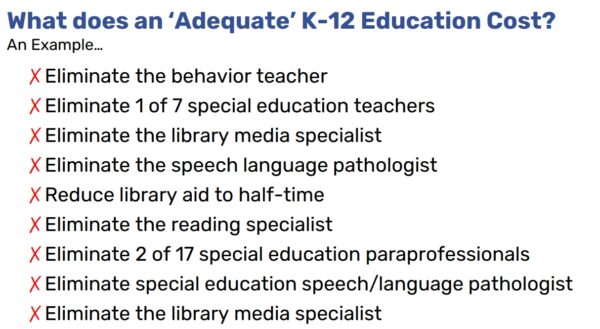
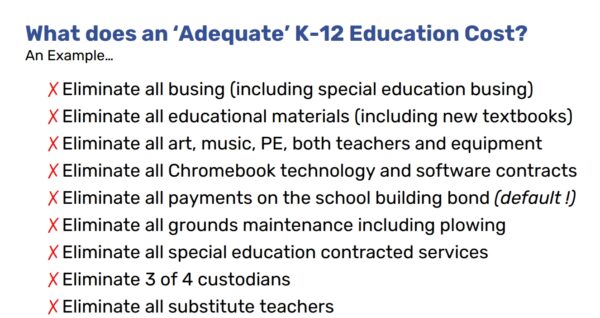
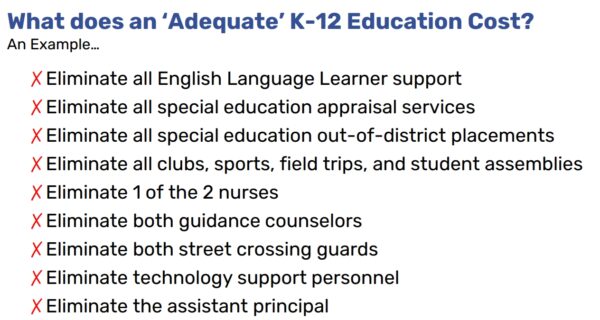
Even after all of these cuts, many of which violate State law, Federal law, and local collective bargaining agreements, they still weren’t at their adequacy budget. The next item to go was the tuition payment to Pembroke Academy. Allenstown does not have its own high school, and pays to send students to Pembroke Academy for grades 9 through 12. Since they can’t control the line item, they cut it, meaning an “adequate” education in Allenstown would end in the 8th grade.
And even that was not enough. Based on the State’s definition of adequacy, during this thought exercise Allenstown tried to keep as many teachers as possible, since that was the State’s focus. But to get down to their adequacy budget, they had to cut half of their teaching positions, resulting in class sizes that violate State standards.
This begs the questions, is this an “adequate” education? Do you think the State is contributing enough add to ensure students have an adequate education, as is their right in the NH Constitution?