Budgets are about choices. The things we decide to fund as a state show where our priorities lie. So what does the state budget that was signed into law today say about New Hampshire’s priorities?
Let’s look at the Interest and Dividends Tax (I&D). The budget includes the repeal of this tax, which is paid on income generated through wealth, excluding things like wages, salaries, and capital gains. The NH Fiscal Policy Institute estimates that 87% of Granite Staters live in households that do not pay this tax, and more than half of all revenue is paid by people earning more than $200,000 in interests and dividends. To generate that much income, a person needs to have millions of dollars in investments.
This tax break for New Hampshire’s wealthiest residents will result in the loss of about $135 million in annual revenue for the state. That is the choice the legislature made in its budget. But what are some other choices they could have made for that money?
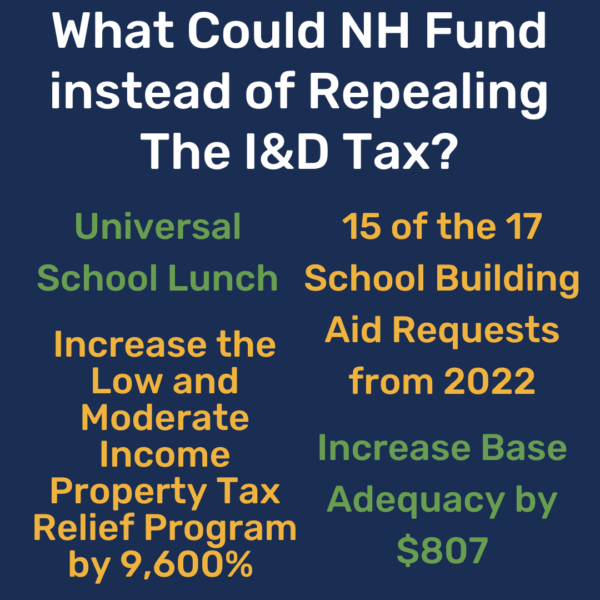
- Universal School Lunch: In 2022, the NH Department of Education estimated that a universal school meals program, in which every single student would be able to eat lunch at school without having to pay, would cost the state around $111 million. The State Senate opted not to include a less expansive program, where all students eligible for Medicaid would automatically be eligible for free or reduced price lunch. This would have helped enable between 6,000 and 7,000 more students to have their meals covered by the program who are already eligible to receive meals. Governor Sununu included $30 million in his budget proposal to fund the direct certification program, but it was not included in the final budget.
- School Building Aid: Currently, the State pays out up to a cap of $50 million a year in school building aid grants. In 2022, there were 17 approved school building aid projects that totaled $227 million, so not all of them would be funded. On its own, I&D revenues could fund 15 of the 17 projects at the cost of $123 million. If I&D revenues were added to the existing funds available, 16 of the 17 projects would be funded. While there were multiple proposals to increase the amount of money in the building aid program, they did not make it into the final budget.
- Property Tax Relief: The state’s Low and Moderate Income Homeowner Property Tax Relief Program paid out $1.4 million to eligible homeowners in 2022, and $47.5 million since its creation in 2002. In 2021, the average amount of relief homeowners received was only $236, which is a tiny faction of the average property tax bill of $7,470 felt be every household. Instead of a tax cut for our State’s wealthiest residents, we could drastically increase the size and eligibility for this program that could provide tax relief to the people who need it the most.
- Increase Base Adequacy: If you divide the estimated $135 million in I&D revenues evenly across all public school students in New Hampshire, you could increase base adequacy by $807 per pupil. That would provide property tax relief across the state by increasing the State’s share of funding for education.