It’s a New Year, but New Hampshire still faces an old problem: deep and enduring inequities in educational opportunity and enormous differences in property taxes. The tremendous gap between what the State has determined to be the cost of an adequate education – about $4,700 per student on average – and the costs communities actually bear – roughly $19,300 per student on average – are a glaring testament to these injustices, as are school property tax rates that range from $2.27 to $20.89 per $1,000 of value.
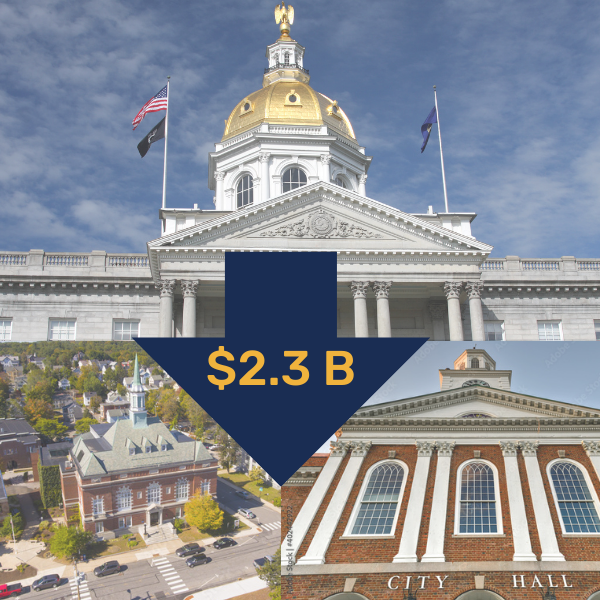
These two injustices, in turn, arise from a single source. The State of New Hampshire has failed for decades to fulfill its fundamental responsibility to provide an adequate education to every child. Instead, it has shifted that responsibility onto local property taxpayers, forcing them to bear $2.3 billion in costs each year, costs that should be met with state revenues.
That really is the heart of the problem. As a result, the heart of the solution is clear.
The only remedy to such injustices is to end that downshifting and to make sure the State of New Hampshire meets its responsibility, once and for all. But, that’s not news to most Granite Staters. New polling from Hart Research, commissioned by the NH School Funding Fairness Project shows 61% of Granite Staters support a statewide education funding system. To achieve greater equity for both students and families the State of New Hampshire must generate the $2.3 billion in funds that local property taxpayers now put up each year.
Importantly, in shifting responsibility for providing an adequate education to the State, back to where it belongs, any revenue source that is put in place at the state level must be aimed at replacing existing local school property taxes, so that families and business owners are not further buried in unaffordable property tax bills.
Data shows the wealthiest New Hampshire residents pay less than 2% of their income in property taxes, while New Hampshire’s middle class pays more than 6% of their income to property taxes. And, polling confirms, 63% of Granite Staters favor an education tax system based on one’s ability to pay. Ensuring New Hampshire meets its fundamental responsibility does not necessarily mean that total amount of school funding throughout the state will go up or go down. What will change is who pays for our public schools – and how.
In the months ahead, NHSFFP will be actively leading the conversation about the critical importance of lifting responsibility for providing an adequate education off of local property taxpayers and putting it where it should have been all along – the State of New Hampshire. As part of our 2022 “Get on the Bus” tour, we’re traveling to 25 communities in 5 months to empower hundreds of Granite Staters to take action on this vital issue. We owe it to everyone in the Granite State – students, parents, and taxpayers – to address this issue head on.