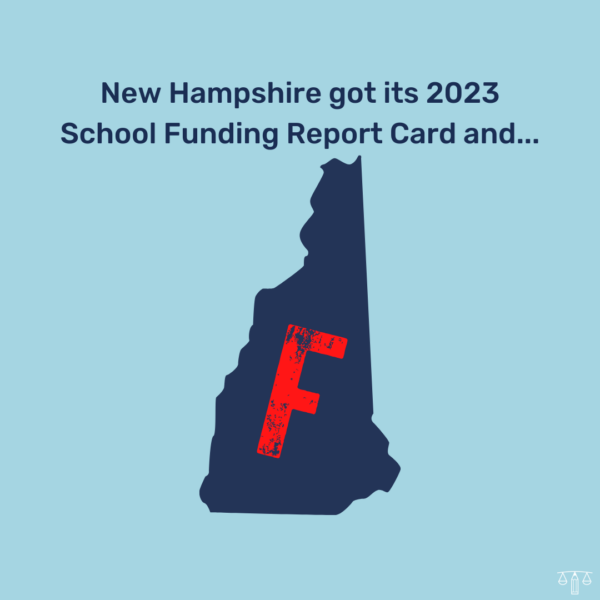
According to the Education Law Center’s 2023 Making the Grade report, which studies school funding fairness in all 50 states, New Hampshire has one of the most regressive school funding structures in the country, earning a grade of F.
A fair school funding system must deliver more funds to students with the most needs. The ELC report defines a “regressive” school funding structure as one that delivers less money per pupil to high-poverty districts than to low-poverty districts. Overall, ELC calculated that NH spends 18% less (or the equivalent of $3,680 per pupil) on high-poverty students than low-poverty students.
New Hampshire earned high marks for its overall funding level (grade A) and a passing grade on funding effort (grade C), as measured by the share of state GDP spent on education. However, these grades come with caveats. While the statewide average per-pupil expenditure is high, and while the state spends a significant portion overall on education, relative to its capacity, that is because local communities vote to support their schools with local property taxes while the State ignores its constitutional responsibility to fund education.