
How one New Hampshire community is holding its schools together amid rising costs and an uncertain funding system
On a cold New Hampshire morning in January, Pembroke Hill Elementary School students are already engaged in the work of the day. Teachers move between classrooms with familiarity and ease. There is no rush, but there is momentum.
That sense of purpose is not accidental. It reflects years of deliberate decisions about how this school shows up for its students, even as resources have tightened.Wendy Gerry, the principal of Pembroke Hill Elementary School, has been in the role for six years. As she walks through the building alongside School Board Chair Melanie Camelo and Superintendent Jessica Bickford, she describes a shift the school made several years ago, when staff began asking: what does equity actually look like in practice?
“It’s not just about curriculum or schedules,” Principal Gerry explains. “It’s about making sure every child has access to a robust learning experience.” At Pembroke Hill, equity is defined through access. Access to grade-level curriculum. Access to early intervention. Access to a learning environment where students are not separated from opportunity based on need or circumstance.

In classrooms, the philosophy is illustrated through walls full of writing examples, tools and resources that children use to learn everyday. In a first-grade room, writing takes center stage as students are guided through a checklist to assess their own work. Jennifer McCarthy, a first-grade teacher and the school’s math curriculum coach, describes the work as foundational. “It’s not just academics,” she says. “It’s social development, too. Every child deserves access.”
Equity through access depends on shared expectations for learning, enough time to plan, and committed adults who know how to meet students where they are without lowering academic expectations. Many of the adults at Pembroke Hill have deep roots in the district. Sandra Valine, a fourth-grade teacher, has taught in Pembroke for four decades. “I love watching them grow,” she says, “as readers, mathematicians, scientists… their energy keeps me here.”
That longevity is central to Pembroke’s identity, as a school district with rich ties to its community. “Teachers come here and stay,” Melanie Camelo says. “They end up teaching the children and even the grandchildren of former students.”
That stability was tested in 2024.
After voters rejected the proposed school budget, the district implemented a $3M reduction that eliminated 27 teacher and staff positions. Major programmatic cuts impacted all three schools. Building improvement plans were halted, and educators absorbed new responsibilities to minimize disruption to students while teachers and staff were left in a ripple effect of fear and distrust.
The wounds left in the aftermath of the budget cuts still feel fresh for those that lived through it. As long as the community suffers with high property tax rates and the affordability crisis bears down on NH residents, the schools will be on high alert. In Pembroke, the property tax rate is 45 percent higher than the state average. In the recent ConVal and Rand school funding lawsuits, the Courts ruled that the State was not adequately funding public education but was downshifting costs onto local property tax payers. Schools are working hard to center their students, but they are over-burdened and under-funded by state policies that are not properly invested in the future of our communities or the well-being of our children and families. That threat can drive division and instability, but it is not keeping passionate educators from doing their work.
Second-grade teacher Joanne Rautio is excited to establish a new school garden thanks to a Farm to School grant award, connecting nutrition, science, and hands-on learning. The school also partners with End 68 Hours of Hunger, serving students who experience food insecurity to bridge the weekend gap (approx. 68 hours) between school meals. Food insecurity is a growing issue in Pembroke. About 22% of students in the district receive free or reduced price lunch.
At Three Rivers Middle School (grades 5-8) Catherine Gagne is in her first year as principal, though it is her nineteenth year in the building. She began as a school psychologist, later served as assistant principal, and now leads a school she knows intimately. “Middle school is where kids really learn who they are,” Principal Gagne says. “And they need consistency to do that.”
Three Rivers’ vision describes a caring community that embraces the diversity of individual students while fostering respect, responsibility, and a passion for lifelong learning. Values like grit, integrity, respect, and responsibility appear throughout the building, shaping how adults respond to behavior and students learn to regulate emotions and repair relationships. Each Friday morning begins with Connections Groups, where students meet in small groups with the same adult advisor throughout their four years in the building. The goal is simple: ensure every student is known.
In the library, Andrew LaFlame, the school’s librarian and digital learning specialist, has transformed the library space, which stands at the entrance to the building, into the vibrational heartbeat of the school. Students respond to daily question prompts as they arrive and are encouraged to use the library as a place to think and work. In science classrooms, learning is applied and collaborative. Ian West partners with the Vermont Energy Education Project to guide students through engineering challenges focused on insulation and energy transfer. Students use spreadsheets to collect, analyze, and share scientific data. As Superintendent Bickford notes, “Being able to use technology effectively isn’t extra, or enrichment. It’s a basic necessity to succeed in the world and workforce.”
Pembroke Academy, the district’s public high school, serving just over 700 students from Pembroke and the neighboring communities of Allenstown, Chichester, Deerfield, Hookset, and Epsom, welcomed Derek Hamilton as their new headmaster only six months ago. Hamilton worked for the Pittsfield NH school district for 20 years before coming to Pembroke.

The school’s goals are simple: Work Hard. Be Respectful. Be a Spartan. They describe expectations for presence, perseverance, reflection, and community responsibility. These goals align with the school’s Vision of a Graduate, which emphasizes communication, creativity, collaboration, and self-direction. Across the district, the message is consistent: there is something here for everyone.
This work has not gone unnoticed. It is a legacy generations of teachers, families and students aim to protect. In recent years, Pembroke educators and schools have received statewide recognition, including 2024 New Hampshire Teacher of the Year Elizabeth Duclos, 2024 Special Educator of the Year Paula Dyrkacz, and the 2023 EDies High School of Excellence award.
Pembroke Academy, known for its excellence in D2 athletics, is also lifting up students who may not otherwise find themselves surrounded by bleachers full of their peers, cheering them on. Unified basketball games bring the entire school into the gym. “It’s the best day of the year,” one staff member says. Unified sports are inclusive programs combining individuals with disabilities (athletes) and without (partners) on the same team for training and competition. At Pembroke Academy, the unified basketball games have become a community-wide beacon for inclusion, belonging, and school pride.
Unified programs aren’t only found on the basketball court, however. Unified woodworking, music, social studies, physical education, and Spanish programs engage students and staff across the lines of special education and leadership.
Matthew Benard, a long time teacher who made the jump from social studies to woodworking, lives into his love of learning and teaching by connecting his students to the greater community. (Apparently, his class is so popular, it can take several years to land a place on his roster.) Mr Benard seeks out projects within the community that he can support, most recently building an accessibility ramp for a resident in need, and a chicken coop for a family farm.
Past the woodworking room, the buzz and glow of fish tanks, terrariums, and a collection of animal skulls draw in students who are curious about the world through science. In his thirteenth year at Pembroke Academy, Gregg Whitmore teaches many classes, including advanced biology and botany. He said students often begin class by checking on their plants in the commercial-sized greenhouse attached to his room. In the spring, students participate in a community plant sale.
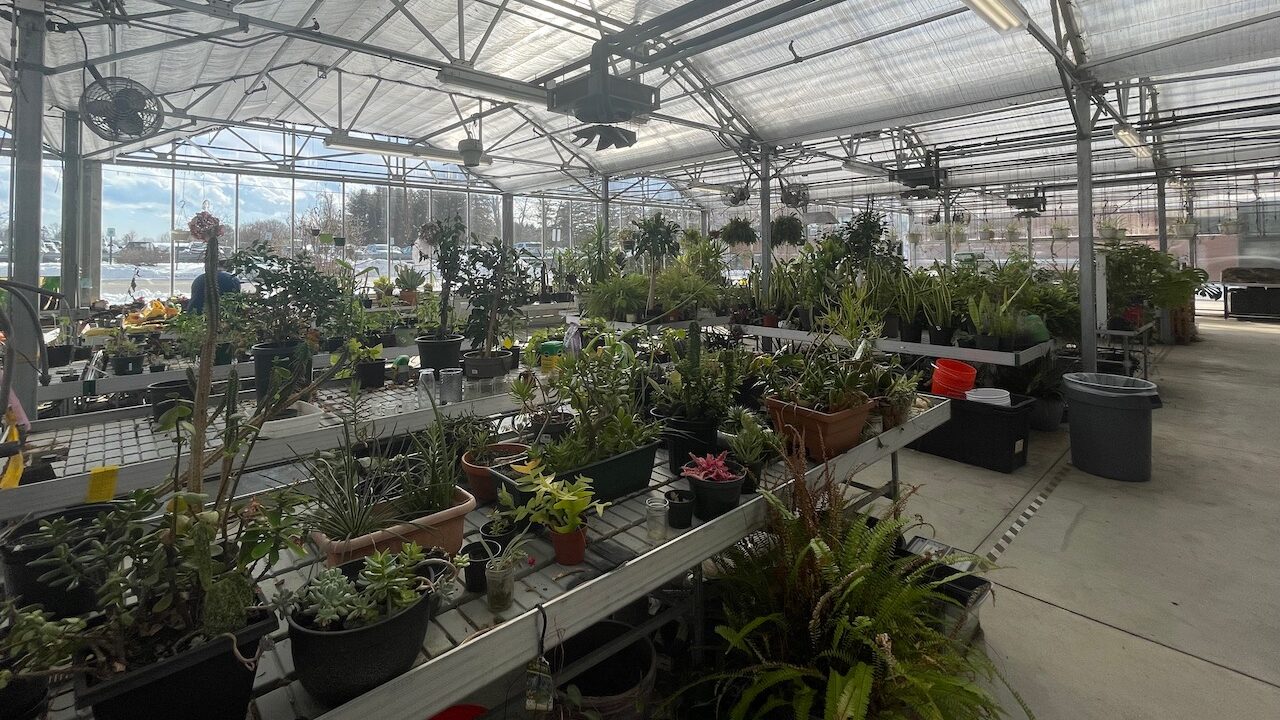
Here in the warmth of the greenhouse, Sam, a senior, explained the automated watering system he built so his plants could survive school breaks. Using five-gallon buckets, tubing, and a bluetooth-controlled valve he can manipulate from his phone, Sam ensured his tomatoes were watered daily. “I just didn’t want them to die over vacation,” he says. Sam’s system works because he was given the tools, the space, and the trust to build it.
Across three schools, Pembroke’s educators are designing systems that work for students, even when the larger system does not work for them. A little over 20% of the school’s budget is earmarked for special education and mandated services, an investment with whole-community benefit. Public schools are one of the primary institutions able to meet the rising tide of need in our communities, but will our State funding policies reflect the level of support schools need to implement and manage federal- and state-imposed mandates?
On March 9, 2025, Pembroke voters approved a $33.4 million school budget for the 2025–2026 school year, a nine percent increase over the previous year. The budget included funding for paraprofessionals in kindergarten classrooms and long-deferred improvements to school facilities. It also resulted in a $1.84 increase per $1,000 of assessed value in the local school property tax rate.
Less than a year later, on January 5, 2026, the SAU 53 School Board invited state legislators to Pembroke Academy for a community-wide conversation about public education. Residents showed up in large numbers, many to express pride in their schools and concern for their future. Others spoke about the pressure of rising costs, stagnant wages, and a system that relies too heavily on local property taxes to fund what is fundamentally a public good.Pembroke, as both a district and a community, is not asking whether public education matters. The answer is visible in daily acts of care and commitment, from thoughtful classroom preparation to after-school programs, from ensuring children are fed to supporting student innovation. What remains unresolved is whether New Hampshire’s funding system will meet communities like Pembroke with the same level of commitment, trust, and care that these schools show their students and families every day.
___________________________________________________________________________
Written by Ashley Wade, Communications Director at the NH School Funding Fairness Project on January 29, 2026.