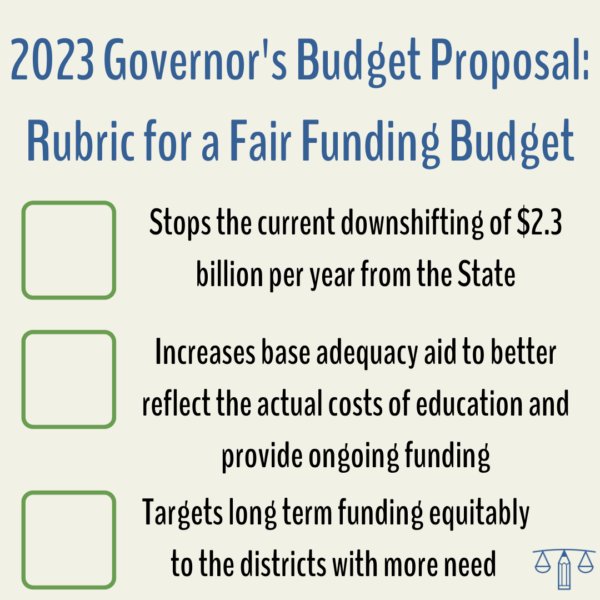
In advance of the Governor’s budget address on February 14, the NH School Funding Fairness Project (NHSFFP) is releasing a rubric to grade the Governor’s budget proposal on how it addresses education funding.

“This budget is an opportunity for the State to fix our broken school funding system and fulfil its constitutional responsibility to fund education,” said Zack Sheehan, NHSFFP Project Director. “Each year, the State downshifts about $2.3 billion onto local property taxpayers. Shifting this responsibility back to the State where it belongs will help reduce property taxes around the State. To be clear, one-time “fixes” are not the solution. Our students, school districts, and taxpayers deserve long term, sustainable funding from the State.”
The exclusion of some targeted aid programs from the 2022-2023 budget only served to exacerbate the existing inequities present in our school funding system. These inequities have continued to persist despite multiple NH Supreme Court rulings clearly deciding that the State has an obligation to fund a public education for all students and must use uniform taxes to do so.
“The state budget is the single largest opportunity for the legislature to make the changes to school funding that were promised in the Claremont decision. The lack of state funding and downshifting to local property taxpayers are the result of laws that could be changed if the Governor and Legislature decided to set aside the lack of political will that has surrounded school funding for 30 years,” Sheehan said. “If they wanted to, they could fix this right now, or fix it with this budget. They have the power, and I believe the responsibility, to do so.”
A budget that addresses school funding in an equitable and ongoing manner could include items like shifting the funding responsibility to the State to relieve pressure on local property tax payers, increasing the amount of base adequacy grants to better reflect the actual cost of education in New Hampshire, reinstating State collection of Statewide Education Property Tax revenues, and targeting funding to districts with higher needs. There are other paths that were presented by the Commission to Study School Funding that the legislature has not considered.
These provisions, even if they do not address the totality of the $2.3 billion burden the State downshifts onto local property tax payers every year, will be a major step in the right direction. The current situation is so untenable that there are two separate school funding lawsuits being litigated against the State. Regardless of the outcomes in court, the Governor and Legislature will likely still be responsible for making the statutory changes necessary to comply with the rulings.
“There is no doubt that this is a very complicated problem, but I hope this framework can be a helpful tool for evaluating whether this budget addresses our school funding problems in a meaningful way,” Sheehan said. “This budget is an opportunity to bring about the changes that students and taxpayers so desperately need. We as a state can’t let this opportunity pass us by and continue with the status quo.”