News
State Asks NH Supreme Court to Overturn Claremont in School Funding Appeal
Aug 17, 2026
This analysis reflects our initial review of the State’s brief filed August 14, 2026.
Last week, the State of New Hampshire filed a 125-page brief asking the New Hampshire Supreme Court to overturn the latest lower-court ruling in the Rand school funding lawsuit. But the brief goes well beyond asking the Court to reverse one decision.
The State gives the Court a series of options, ranging from overturning more than three decades of school funding precedent to much narrower reasons for throwing out the case. Taken together, the arguments move in a consistent direction: preserve the current funding structure while reducing the State’s legal responsibility for the inequities and property tax pressures that structure creates.
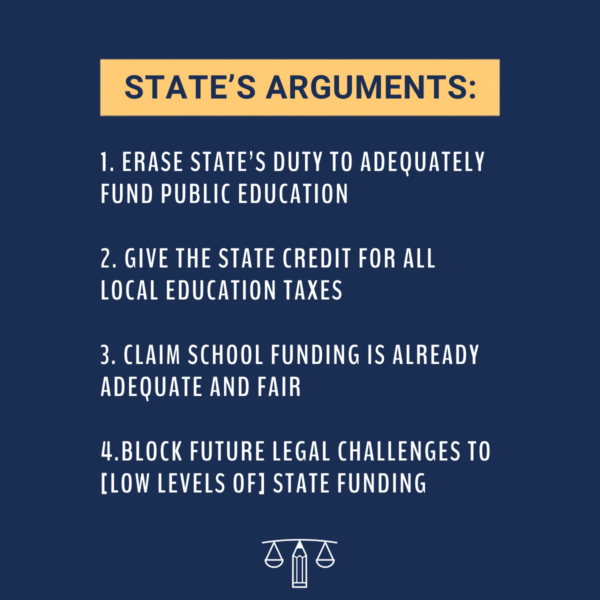
Here are the major arguments and what they could mean.
The State’s broadest argument is that both Claremont rulings were wrongly decided.
For more than 30 years, the Claremont decisions have established that the New Hampshire Constitution guarantees every child the opportunity for an adequate public education and places responsibility on the State to fund it. The State now argues that this framework has no sufficient basis in the text or history of the Constitution.
That would not make the costs of education disappear. Schools would still have to meet State requirements and provide teachers, transportation, facilities, technology, special education services, and other basic resources. What would change is who can be held constitutionally accountable for making sure those costs are funded.
This would also mean reversing precedent the NH Supreme Court reaffirmed as recently as July 2025. In ConVal, the Court noted that it had “time and again” reaffirmed the basic Claremont obligation.
If the Court will not overturn Claremont entirely, the State proposes another option: treat State government, towns, and school districts collectively when determining whether the constitutional funding obligation has been satisfied.
This closely tracks the “shared responsibility” language signed into law through HB 1815 earlier this year. HB 1815 describes State and local entities as collectively responsible for public education and local governments and school districts as “indivisible from the state.” A few months later, the Attorney General is now relying directly on that language in the Rand appeal.
This is why HB 1815 mattered. It did not increase base adequacy funding, lower property taxes, or determine what an adequate education actually costs. It changed how responsibility is described.
Under the State’s proposed rule, if Concord provides less than is necessary and a community raises the rest locally, those local dollars could help demonstrate that the State’s constitutional obligation has been fulfilled. The local tax bill does not get smaller. The State simply gets credit for money local taxpayers are already paying.
That also turns the idea of “local control” on its head. Local control should mean communities can choose how to strengthen their schools beyond a statewide minimum. It should not mean the State can establish minimum requirements, leave communities to fund them, and then count those local taxes as part of the State’s contribution.
The State also argues that decades of school funding cases have created an unworkable system. According to the brief, legislators cannot know exactly what a court will consider sufficient, litigation keeps producing new requirements, and judges are increasingly drawn into decisions about staffing, transportation, facilities, and other school costs.
The State goes one step further and argues that determining what an adequate education costs and how it should be funded is a political question that courts should not review.
There are two major problems with that framing.
First, before arguing that the constitutional standard is impossible to satisfy, it is worth asking whether the State has seriously tried to demonstrate that its existing funding satisfies it.
In ConVal, Judge David Ruoff found that “the State did not offer affirmative evidence justifying the sufficiency of the current funding level.” Last July, the Supreme Court specifically said that “the record confirms” that finding.
Two State experts offered no opinion about what an adequate education actually costs or why existing base funding was sufficient. One acknowledged that he did not know the necessary components or their cost. Another argued that reliably costing adequacy was not feasible.
Judge Ruoff reached a similar conclusion again after the Rand trial, finding that the State offered no affirmative evidence justifying current adequacy funding or special education differentiated aid.
The recent history, then, is not simply one of courts repeatedly rejecting serious State attempts to calculate adequacy and moving the goalposts afterward.
Second, the ConVal ruling from July of last year itself demonstrates that judicial oversight does not require courts to take over the State budget.
The Supreme Court affirmed that State base adequacy funding was unconstitutional but reversed Judge Ruoff’s order requiring the State to immediately begin paying a higher amount. The Court distinguished between identifying a constitutional violation and deciding exactly how the Legislature must remedy it.
The State’s new argument goes considerably further. It asks the Court to conclude that the underlying funding question itself should largely be beyond judicial review.
If the Legislature gets to decide what its constitutional obligation requires, how much it will pay, and whether that amount is sufficient, the ability to enforce the constitutional right becomes significantly weaker.
The brief also gives the Supreme Court several ways to reverse Rand without deciding these larger constitutional questions.
The State argues that these particular property taxpayers are not the right plaintiffs to bring the case. Judge Ruoff disagreed, finding that taxpayers in higher-tax communities suffer a concrete financial injury when insufficient State funding pushes more of the cost onto their local tax bills. A ruling for the State on standing would not establish that current funding is adequate; it would simply mean these plaintiffs cannot challenge it this way.
The State also rejects the lower court’s conclusion that local property taxes used to cover part of constitutional adequacy effectively become State taxes subject to Claremont’s requirement that such taxes be uniform statewide. The State says a town tax remains a town tax regardless of what the money ultimately pays for.
The problem with that argument is its assumption that the local spending is voluntary. If State law requires every district to provide certain educational opportunities but State funding does not cover those requirements, communities cannot simply choose not to educate their students. They have to find the money somewhere and, in New Hampshire, that overwhelmingly means local property taxes.
The State similarly argues that plaintiffs did not prove which specific local dollars filled the adequacy gap because communities receive other revenues they could use instead, including unrestricted State money.
But that creates an obvious tension: to prove those other revenues can cover the gap, we first have to know how large the gap is. That requires determining what adequacy costs, which is the same exercise the State argues courts should not undertake.
Finally, the State challenges the Rand ruling on special education funding. Its argument is not that schools can ignore IEPs or federal requirements. Instead, it says not every special education expense automatically belongs within the State’s constitutional funding obligation.
That distinction raises a legal question, but it leaves the next questions unanswered: Which special education services are part of constitutional adequacy? What do they cost? And is current State funding enough? The brief criticizes Judge Ruoff’s answer without providing its own calculation.
The connection between this appeal and the 2026 legislative session is important.
After the Supreme Court ruled in ConVal that base adequacy funding was unconstitutional, lawmakers could have focused on determining the actual cost of adequacy, increasing the State contribution, or examining ways to reduce pressure on local property taxpayers.
Instead, HB 1815 became one of the Legislature’s major responses.
As we wrote during the session, HB 1815 did not increase State funding, lower property taxes, or determine what an adequate education costs. It changed the framework of responsibility without solving the underlying problem.
The Rand brief now relies directly on that framework to argue that local spending should count toward fulfilling the State’s constitutional responsibility.
The legal paths in this brief are different.
The Court could overturn Claremont entirely. It could preserve the right to an adequate education but allow local taxes to count toward the State’s obligation. It could declare funding questions largely beyond judicial review. Or it could avoid those sweeping issues and reverse Rand on narrower grounds involving standing, taxes, evidence, or special education.
But underneath all of those arguments remains the same basic question:
When the State provides less than communities need to deliver the education required by State law, who is responsible for the difference?
What the brief does not do is resolve the question that has driven these lawsuits for years: What does an adequate education actually cost, how much of that cost is the State currently paying, and why should the existing amount be considered sufficient?
In ConVal, the Supreme Court found that current base adequacy funding was not sufficient and confirmed that the State had failed to present affirmative evidence defending that amount. In Rand, Judge Ruoff again found current State funding insufficient.
Changing the legal framework does not make the underlying costs disappear. Families will still receive property tax bills. School boards will still have to balance budgets. Schools will still have to meet State requirements.
The question before the Supreme Court is about constitutional law. For students, taxpayers, and communities, the consequences are much more concrete.