
Over the past several months, communities across New Hampshire have been forced to make wrenching decisions about local school finances, raising already-high property tax rates and cutting back the educational opportunities available to students. Those decisions have come in response to an expected $90 million decline in state education aid in FY 2022, due both to expiring law and the impact of the COVID-19 pandemic.
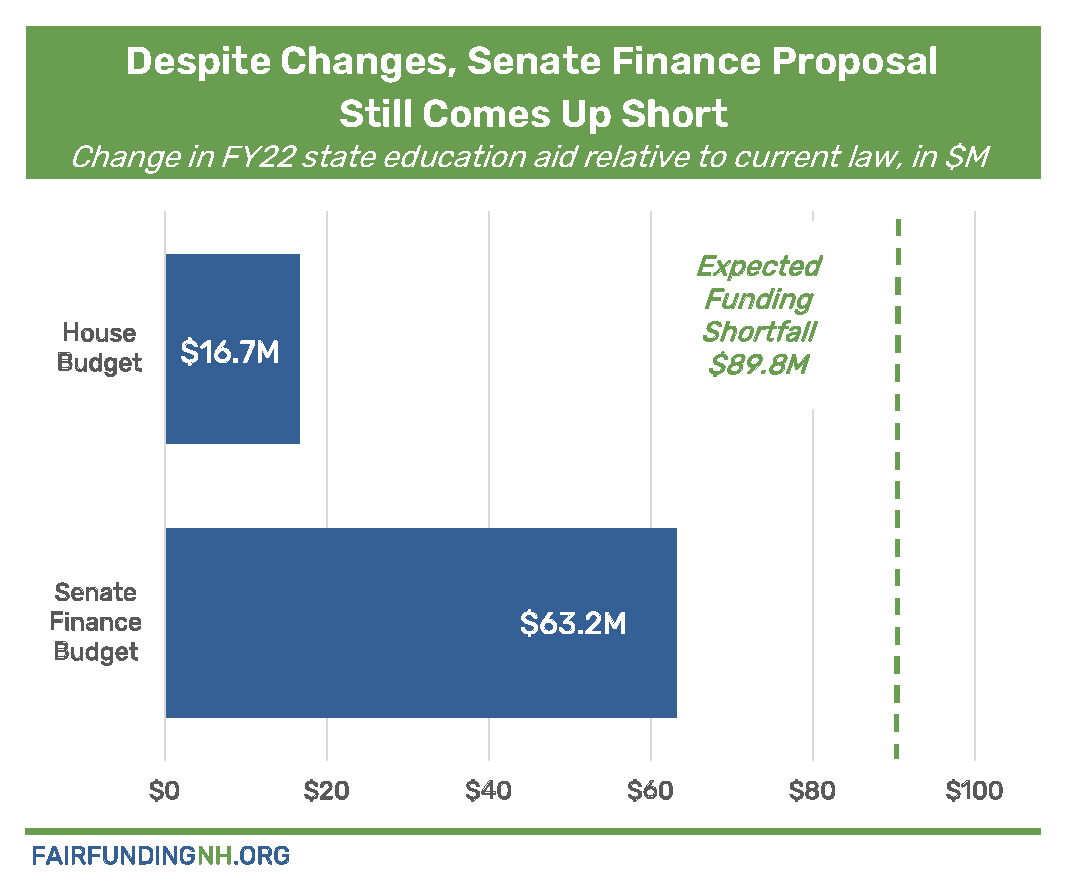 The window for state policymakers to prevent that decline and allow communities to undo the most damaging decisions is rapidly shutting, as the New Hampshire Senate will vote next week on its version of the FY 2022-2023 budget. When it meets, the Senate will consider a budget plan, approved by the Senate Finance Committee earlier today, that fails close the entirety of the school funding gap next year.
While the Senate Finance plan would make the changes in law necessary protect school finances against the consequences of the pandemic, the Committee voted down attempts to maintain fiscal capacity disparity aid to property-poor districts; the pending expiration of such aid is a key contributor to the projected $90 million shortfall. The Committee elected instead to keep in place the House of Representatives’ poorly-timed and poorly-targeted reduction in the Statewide Education Property Tax (or SWEPT) in FY23. Moreover, though the Senate Finance budget proposal would institute a new and permanent form of aid designed to assist communities with high concentrations of low-income students, it, like the House’s version of the budget, fails to advance more comprehensive and much-needed funding reforms, such as those recommended by the recent Commission to Study School Funding. In total, the budget approved by Senate Finance would address only about $63 million of roughly $90 million decline in state education aid between FY 2021 and FY 2022, while the House’s budget would add back just $17 million in the coming year.
Before they approve their version of the budget and enter into negotiations with the House, Senators should reconsider the Finance Committee’s decision and extend fiscal capacity disparity aid. Doing so would direct vital resources to communities struggling to support their local schools and preserve some measure of progress toward a more equitable school funding system.
The remainder of this fact sheet describes some of the key school funding elements of the Senate Finance Committee’s FY22-23 budget plan.
Pandemic-Related Changes
The version of the FY22-23 budget backed by Senate Finance incorporates the provisions of legislation (SB 135) unanimously approved by the full Senate in February. Those provisions are designed to forestall reductions in state education aid in FY 2022 due to temporarily lower student counts associated with the pandemic. More specifically, data from the New Hampshire Department of Education indicate that attendance has declined by about 4 percent over the past year; the same data point to a roughly 24 percent decrease in the count of students eligible for free and reduced price meals. Given the one year lag in the data used to determine state education aid, such artificially suppressed numbers would lower state aid just as schools resume in earnest for the 2021-2022 academic year.
In response, the provisions added by Senate Finance would, for FY22, compare a district’s total student enrollment and its count of students eligible for free or reduced-price meals across the 2019-2020 and 2020-2021 school years. In both cases, the greater of those years’ figures would be used to determine state aid, negating potential funding cuts from reduced enrollment and reduced reporting on students eligible for food assistance.
Expiring Law and New “Relief Funding”
Under current law, communities that face economic hardships are eligible to receive two forms of targeted education aid. The first, known as fiscal capacity disparity aid, is designed to assist cities and towns with comparatively low property values; the second, often called additional aid, is intended to provide additional resources to localities with high concentrations of low-income students, as measured by the share of students eligible to receive free- or reduced-price meals. Unfortunately, both forms of aid are scheduled to expire at the end of the current fiscal year. 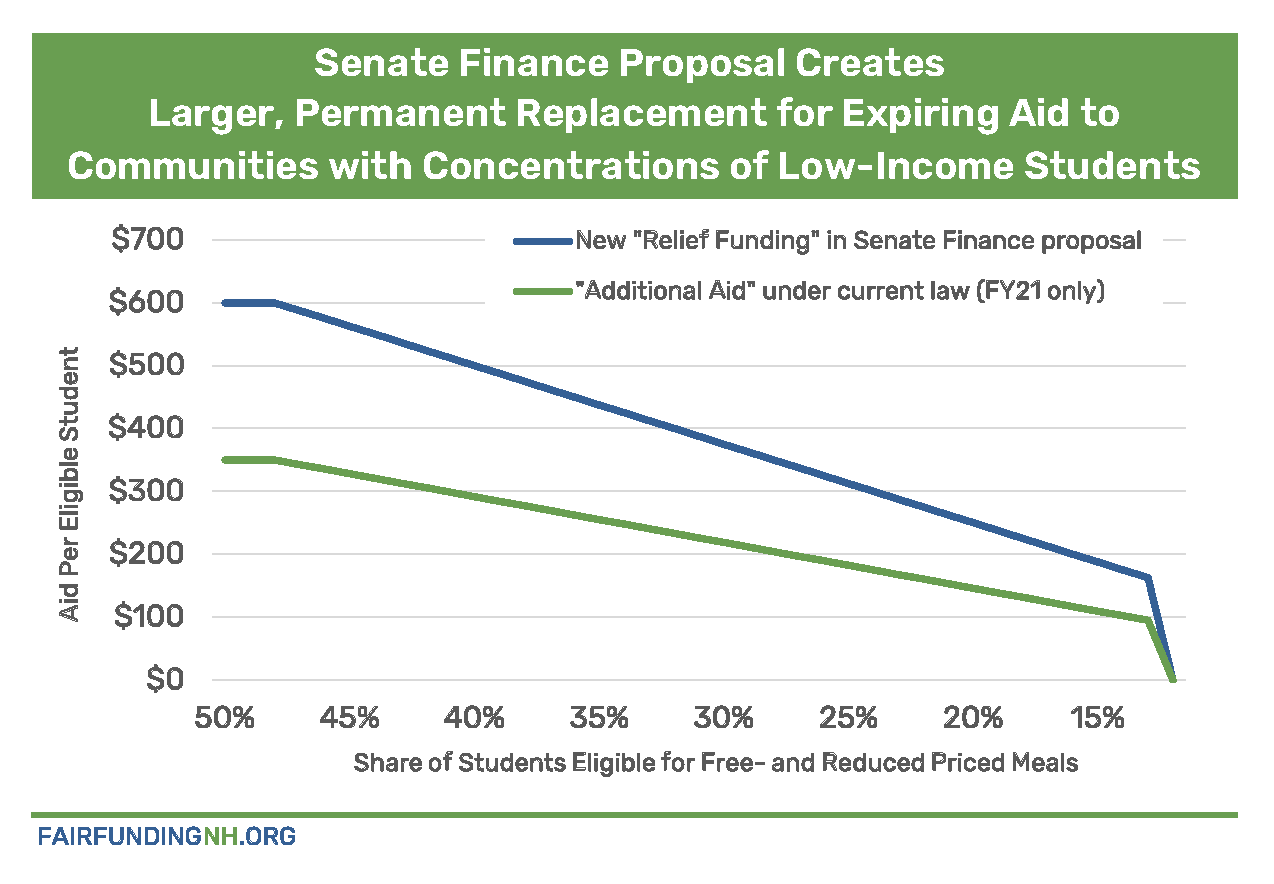
Senate Finance rejected efforts to extend fiscal capacity disparity aid, thus denying the nearly 100 communities that now receive such aid more than $40 million per year. However, the Committee did, in effect, replace additional aid with a new, permanent, and somewhat more generous form of aid called “relief funding.” Under this new form of aid, school districts in which 48 percent or more of its students are eligible to receive free- or reduced-price meals would receive an additional $600 for each such student. (By comparison, additional aid provides $350 under similar conditions.)
Districts with lesser concentrations of low-income students would receive smaller amounts of aid, but those districts in which the concentration of free- and reduced-price meal eligible students is less than 12 percent would not be eligible for relief funding.
The Committee set the total amount of relief funding to be distributed in each fiscal year at $17.5 million and stipulated that the actual amount each community receives in relief funding would be prorated to reach that target. That is, if initial amounts of relief funding summed to less than $17.5 million, each community would have such funding adjusted upwards until the target was attained; the converse is true if initial amounts exceed $17.5 million. NHSFFP estimates that, in FY22, 164 communities would receive relief funding and 26 would receive the maximum per student amount – prorated to roughly $537 per student to comply with the $17.5 million cap.
SWEPT Reduction
The decision by Senate Finance to allow fiscal capacity disparity aid to expire is particularly misguided, as the Committee simultaneously chose to maintain the $100 million reduction in the statewide education property tax (or SWEPT) that the House of Representatives included in its version of the budget for FY 2023.
The state resources needed to support that $100 million SWEPT reduction could be distributed far more equitably and far more effectively, in part, by preserving fiscal capacity disparity aid. For instance, as NHSFFP has previously noted, less than 5 percent of the funds associated with the SWEPT reduction will accrue to the 20 property-poorest municipalities in the state (as measured by equalized valuation per pupil for 2019-20). In contrast, had Senate Finance set a floor under school funding, such that every community received no less in education aid in each of the next two years than they do at present, more than 20 percent of the benefits from that approach would have been realized by those 20 cities and towns.
Little Progress in Addressing Long-Standing Inequities
While the creation of “relief funding” on a permanent basis constitutes a step forward, overall, the version of the budget recommended by the Senate Finance Committee makes little progress in addressing the long-standing inequities that plague New Hampshire’s school funding system. Even if all of the Committee’s changes were to become law, the resources the State of New Hampshire directs to local school districts to fulfill its responsibility to provide every child an adequate education will remain hundreds of millions of dollars below what is actually needed, year in and year out. Likewise, enormous disparities in property tax rates arising from wide differences in property values and the state’s failure to fulfill its school funding responsibilities will persist, as they have for decades now.
The recent Commission to Study School Funding offered a sound, empirically-based, and student-centered blueprint for beginning to revamp New Hampshire’s school funding system, yet, the Senate Finance Committee, like the House before it, completely ignored that possible path forward. As such, the Committee’s budget proposal represents a missed opportunity, for, as urgent and necessary as solving the problems at hand may be, the time to recast New Hampshire’s funding system as a whole is well past due.
For town-by-town estimates of the impact of the Senate Finance Committee’s budget plan, please click on the pdf icon at the top of the page.
This fact sheet and the accompanying tables, originally issued on May 28, were updated on June 2 to reflect the release of estimates by the New Hampshire Office of the Legislative Budget Assistant.