
What Could Have Been: Missed Opportunities in the 2026–2027 NH State Budget
July 2025
Carly Prescott, MPP
NH State Budget As the dust settles on New Hampshire’s biennial budget, one truth remains: the opportunity to meaningfully address our broken school funding system was right in front of us, and lawmakers chose not to act. Throughout the session, there was growing momentum for change. Advocates, municipalities, educators, and students all made their voices heard, pointing to a school funding formula that continues to overburden local property taxpayers while shortchanging students in lower-wealth communities. Meanwhile, the state continues to rely heavily on local property taxes, which is the most regressive method of raising school revenue, despite court rulings and years of data showing the inequities this creates.
What Was on the Table This budget cycle included serious proposals, some of which would have been beneficial to public education, while others were not.
- Bills were introduced to expand adequacy aid for schools with higher concentrations of need, including students eligible for free and reduced-price lunch and those requiring special education services. These changes would have directed more state dollars to where they are most needed.
- Lawmakers had the option to rework the statewide education property tax (SWEPT), including ending the practice of property wealth communities retaining excess state funds and replacing this regressive funding source with a more equitable approach.
- See a town-by-town analysis of the potential dollars left on the table.
Each represented a meaningful opportunity for progress. Unfortunately, none made it into the final state budget. Instead, policies that funnel funds away from public schools such as universal vouchers were prioritized.
Here’s a closer look at the proposals that offered real hope:
HB 550 – Increasing the Base Cost of an Adequate Education
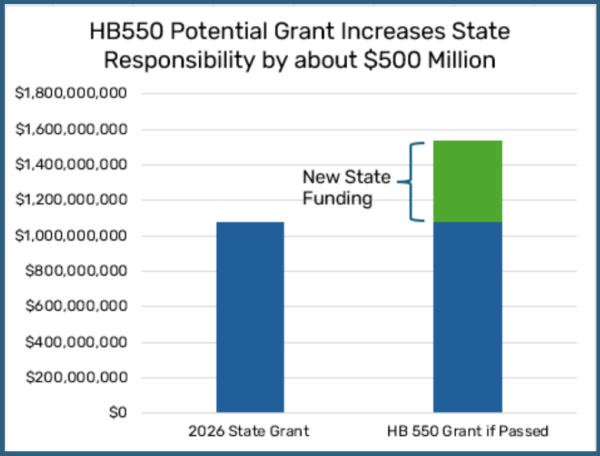
HB 550 proposed raising the amount covered by the State in base adequacy by 72.4% from $ 4,182 to $7,356.01 per student. This legislation also fell in line with the most recent Supreme Court Ruling in the ConVal case, which wrote “we affirm the trial court’s injunction to the extent it established “a conservative minimum threshold of $7,356.01 which base adequacy aid funding must exceed” as guidance for future legislative action.” It would have been a critical step in recognizing the real financial needs of school districts across the state.
This bill was voted Inexpedient to Legislate by the House Education Funding Committee. As demonstrated in Figure 1, this bill would have increased the base amount that is sent to all school districts from the State, regardless of need.
Figure 1
HB 651 – Adjusting Base and Differentiated Aid
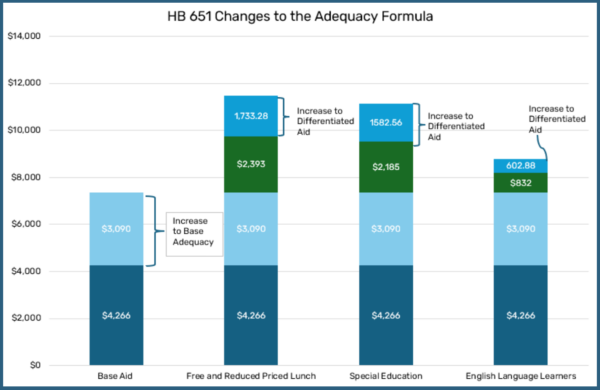
HB 651 went even further, modifying and increasing both the base adequacy amount and differentiated aid provided for students who need more support, including those eligible for free and reduced-price lunch, English language learners, and students receiving special education services. HB 651 acknowledged that equitable funding must account for student need, not just headcount.
Figure 2
Students who face additional challenges, such as poverty, language barriers, or disabilities, often require more support to access the same educational opportunities as their peers. By directing additional resources to these students, schools can provide services like tutoring, counseling, special education, and language instruction.
HB 651 proposed a 72.4% funding increase in every category:
- Base Adequacy Aid: Increase from $4,265.64 to $7,356.01 per pupil (same as the proposal in HB 550).
- Free or Reduced-Price Meal Eligible Students: Increase from $2,392.92 to $4,126.20 per eligible pupil.
- English Language Learners: Increase from $832.32 to $1,435.20 per eligible pupil.
- Special Education Students: Increase from $2,184.84 to $3,767.40 per eligible pupil.
HB 651 was retained in the House Education Funding Committee.
HB 563 and HB 603 – Supporting Special Education Students
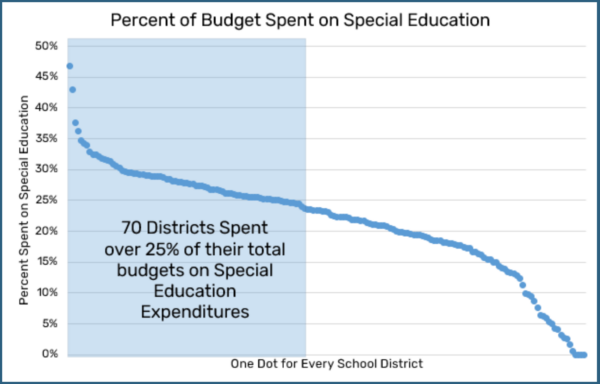
Both bills focused specifically on improving funding for students receiving special education services. Districts across the state report that special education costs are a major driver of budget pressure, and these proposals would have helped reduce the growing disparity between what schools are required by law to provide and what the state is willing to fund.
Figure 3
HB 563 introduced a tiered funding system for special education services that would have increased funding based on the amount of support required:
- Category A: Students receiving special education services inside regular classrooms for 80% or more of the day – $2,185 per pupil.
- Category B: Students receiving services inside regular classrooms for less than 80% of the day – $3,278 per pupil.
- Category C: Students in separate schools, residential facilities, or homebound/hospital placements – $7,648 per pupil.
This proposal would have cost the state just $7 million for the 2026 school year, a .0.7% increase in its current special education expenditures of $978,485,932. However, this bill received pushback from advocates over concerns it would violate the Federal Individuals with Disabilities Education Act (IDEA). HB563 was retained in the House Finance Committee.
On the other hand, HB 603, as introduced, proposed increasing the differentiated aid for students receiving special education services from $2,100 to $29,556 per pupil. This figure was based on the average additional cost of providing special education services during the 2023– 24 school year, as reported in our 2024 Special Education policy report (linked here). This proposal would have increased state grants by over $700 million, shifting that responsibility from local property taxpayers. HB 603 was voted Inexpedient to Legislate by the House Education Funding Committee.
HB 669 – Reforming the Statewide Education Property Tax (SWEPT)
HB 669 proposed a uniform Statewide Education Property Tax (SWEPT) rate of $5.00 per $1,000 of assessed property value, with all revenue deposited into the Education Trust Fund. This change would have required all SWEPT funds to be pooled and redistributed at the state level, rather than allowing excess revenue to be retained locally.
While this bill served only as a revenue-generating mechanism, by shifting a greater share of responsibility for school funding to the state, HB 669 could have been used to pay for some of the increase funding mechanisms mentioned above and help reduce local property tax burdens in communities across the state. Many communities currently face significant challenges in raising sufficient revenue for education, and a statewide pooling approach could have supported a more equitable distribution of funding across districts.
HB 669 aligned with the concerns raised in an active lawsuit: Rand v. State of New Hampshire. In Rand, plaintiffs challenge the constitutionality of the SWEPT system itself, arguing that the retention of excess SWEPT revenue by property-wealthy towns leads to disproportionate tax burdens across communities. The superior court ruled that this system violates the state constitution’s requirement for proportional and reasonable taxation. But on June 10th, the NH Supreme Court ruled in a 3-1 decision that excess SWEPT retention was not unconstitutional, with Justice Bassett dissenting.
While HB 669 was voted Inexpedient to Legislate, it offered a potential path toward more equitable revenue generation if combined with enhanced funding from the State.
HB 734 – Expanding Property Tax Relief for Low- and Moderate-Income Homeowners
The Low and Moderate Income Property Tax Relief Program (LMIPTRP) is New Hampshire’s only state-level property tax relief initiative, offering eligible homeowners rebates on their SWEPT payments. In 2023, the program distributed only $1.1 million in relief across 5,650 claims, with average rebates of $241. This average rebate covered less than half of a typical SWEPT bill and only a small fraction of total property taxes.
Eligibility is capped at $65,000 for single filers and $77,500 for married or head-of-household filers, with a maximum rebate of $1,100. The average SWEPT bill for an eligible homeowner was about $426, while combined state and local education property taxes can exceed $4,600.
Relief is most concentrated in small, rural towns, where claims per 1,000 residents are significantly higher than in larger cities like Nashua or Manchester. This difference likely reflects higher renter populations in urban areas, who are not eligible for the program.
Despite its targeted support, LMIPTRP remains limited in reach and impact. Expanding eligibility, increasing rebate amounts, or including relief for local property taxes could strengthen the program and provide more meaningful support to low- and moderate-income homeowners.
HB 734 aimed to reform New Hampshire’s education funding system and expand property tax relief for low- and moderate-income homeowners. Key provisions of the bill included:
- Requiring municipalities to send all SWEPT revenue to the state for redistribution, rather than allowing some towns to retain excess funds.
- Modifying the formula for calculating relief to better align with actual tax burdens.
- Creating a committee to study the program’s effectiveness and explore potential expansions, such as extending relief to tenants who indirectly pay education property taxes through rent.
HB 734 was retained in the House Education Funding Committee.
What Did Make It into the Budget?
SB 295 – Universal Voucher Expansion
Rather than investing in critical public services like K–12 education, affordable housing, or childcare, the Governor and Legislature chose to significantly expand the NH school voucher program known as Education Freedom Accounts (EFAs), redirecting tens of millions in public taxpayer dollars to create state-funded accounts that families use to pay for private and religious school tuition, homeschooling costs, and other educational expenses.
In 2024, lawmakers raised the income eligibility threshold for this program to 350% of the federal poverty level, or about $125,000 for a family of four. This expansion came despite strong public opposition and despite the program already exceeding its budget by more than 275% in the prior year.
SB 295 proposed a significant expansion of the state’s voucher program by temporarily raising this cap to 400% in the 2025-2026 school year before eliminating all income restrictions in July 2026, ultimately making the program universally available to every K-12 student regardless of family income. SB 295 was passed as a standalone bill, but funds were earmarked in the budget.
Voucher funds are pulled directly from the Education Trust Fund, reducing the resources available to public schools that serve the vast majority of NH students. Public schools are already strained from staffing shortages, growing special education expenses, and inequitable funding. Additionally, the private institutions receiving school voucher funds are not held to the same standards of transparency, accountability, or nondiscrimination as public schools.
The law’s expansion accommodates up to 10,000 new participants (with a mechanism to increase the cap) a number that has already been reached (1) , potentially costing NH taxpayers an additional $100 million over the next two years and exceeding the existing budget by 186%. (2)
House Version of the State Budget – Passed April 10th, 2025
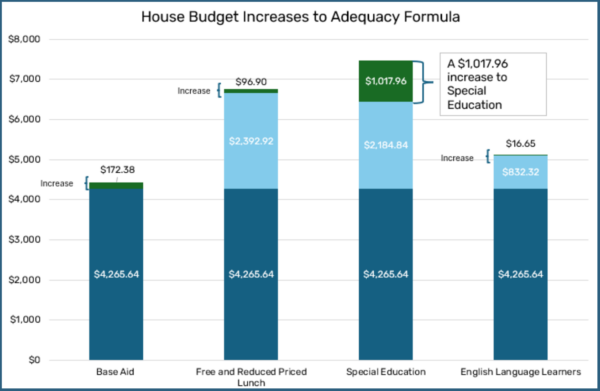
The House effectively killed every option for real, sustainable change in New Hampshire’s adequacy formula. For K–12 public education, the House increased the base Adequate Education Grant by just 2% annually, a measure taken every year to account for inflation, even though inflation was more than 2%. Special education aid received a notable boost, bringing the adequacy amount to over $3,000, and the Fiscal Capacity Disparity Aid program was reinstated, offering targeted support of up to $1,250 per student in property-poor districts, though the formula was capped to limit benefits for the State’s two largest cities, Manchester and Nashua. The House budget included only modest increases for public school funding, with about a 2.5% increase (roughly $29–$30 million in FY2027), primarily through increasing the Extraordinary Needs Grant and restoring the Fiscal Capacity Disparity Grant. Furthermore, the proposal included a permanent, state-mandated school budget cap for all districts, limiting local flexibility regardless of community needs. However, this cap was ultimately removed by floor amendment after widespread local opposition.
Figure 4
The House version of HB2 also included a broad ban on diversity, equity, and inclusion (DEI) initiatives in public schools and for contractors. The language was so vague and expansive that it could impact services for students with disabilities, sports teams, and programs supporting student inclusion. It also gave the Education Commissioner unilateral authority to withhold all state funding from schools deemed in violation, with no appeal process.
Senate Version of the State Budget Passed June 5th, 2025
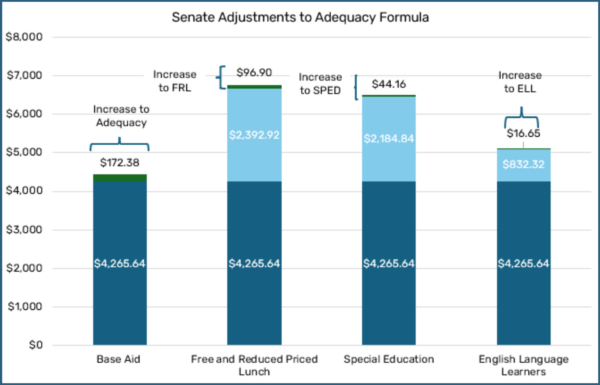
The Senate Finance Committee’s proposed budget maintained the House’s allocations for base adequacy aid and targeted aid for English language learners and students who receive free- and reduced-price lunch. However, the committee eliminated the Special Education differential aid increase proposed by the House, choosing to cap it at the same 2% inflation increase as in prior years.
Notably, this $30 million rollback in special education funding mirrored the approximate increase the Senate approved for the expanded school voucher program, effectively prioritizing private school subsidies over increased support for students with disabilities in public schools.
Figure 5
Committee of Conference Version of the State Budget Passed June 20, 2025
The Committee of Conference (CoC) report introduced several significant changes to education policy and funding. Among the most consequential provisions was a cap on targeted aid for Manchester, limiting funding to $3,750 per student and cutting an estimated $10-$12 million per year from the city’s public schools. The report also included the sweeping ban on “diversity, equity, and inclusion.” Other statewide policy changes included a blanket ban on student cell phone use during school hours and a new cap on the Education Trust Fund surplus, limiting it to $20 million per biennium and sending any additional revenue to the General Fund.
While this version included a requirement that the New Hampshire Department of Education reimburse at least 80% of approved Special Education Aid requests, a long-overdue partial fix to a chronic underfunding issue, it simultaneously weakened the Education Trust Fund’s sustainability by reducing contributions from the business profits tax, tobacco tax, and real estate transfer tax.
The CoC version also included a statement rejecting judicial oversight of school funding altogether, asserting that the Legislature alone determines what constitutes an adequate education, despite ongoing lawsuits challenging the fairness and constitutionality of the current funding system. This is in no way legally binding, but it is another example of the lengths the legislature will go to in order to ignore rulings from the Courts.
In Conclusion
Throughout this budget cycle, New Hampshire legislators had the opportunity to advance policies that would strengthen communities, improve equity, and ensure a more stable future for public education and essential services. Instead, lawmakers rejected a range of thoughtful policy proposals that could have made meaningful progress toward those goals.
The bills highlighted in this report reflect not only what was possible but what is still within reach. They offer a roadmap for a more comprehensive and responsible approach to budgeting that centers fairness, supports students and families, and addresses long-standing structural challenges.
New Hampshire’s future depends on the choices we make today. By revisiting and building on the proposals outlined here, lawmakers have the chance to chart a better path forward, one that reflects our shared values and invests in the well-being of every community in the state.
Download a copy of this report
- Concord Monitor Reporting
- Universal voucher program signed into law despite concerns: Reaching Higher NH